Radiator and Boiler Leaks in DC Row Houses: The Heating-Season Water Damage
BY RESTORATION DOCTOR OF WASHINGTON DC · WASHINGTON DC & SOUTHERN MARYLAND
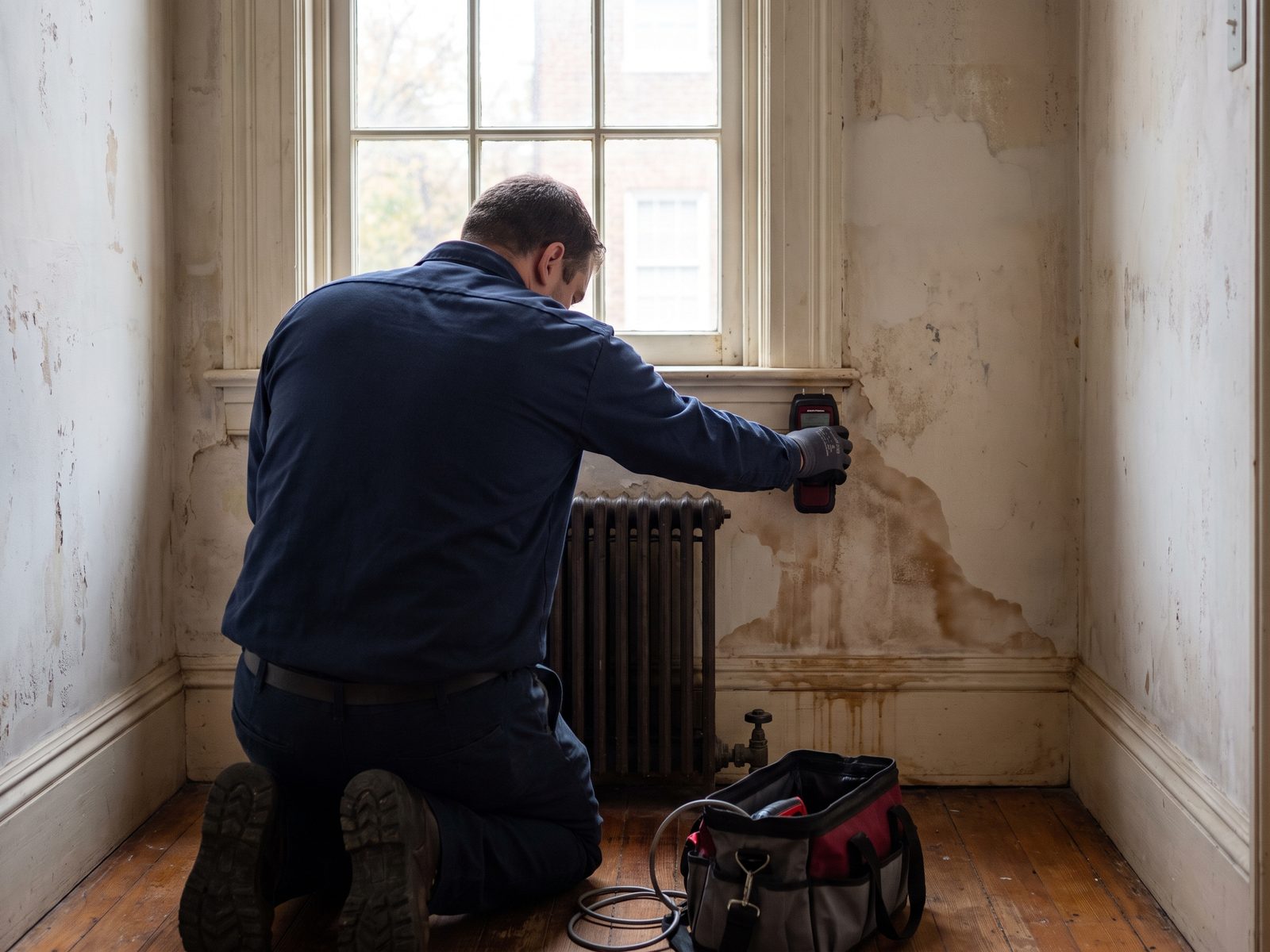
Old D.C. row houses heat with steam and hot-water systems that fail at valves, air vents, risers and the boiler, and the risers run inside plaster party walls. The damage usually shows on a ceiling two floors below the leak, so shut the system down, stop chasing it through the wall, and get moisture mapped before plaster and heart pine take the loss.
Call (202) 922-1444Why do DC row houses still run steam and hydronic heat?
Radiator leak water damage in DC is a heating-season problem rather than a plumbing-season one, because so much of the city's oldest housing stock still heats with one-pipe steam or a closed hot-water loop. Those systems went in when the houses were built, cast iron lasts for generations, and replacing a riser means opening plaster party walls nobody wants to open. Walk a block in Capitol Hill, Petworth or Bloomingdale and you pass radiators that have cycled every winter for the better part of a century.
That is a second set of water-carrying pipes in the house, and unlike your supply plumbing it sits idle for six months, then comes back under heat and pressure on the first cold night. Metal that was dry and still all summer expands. Packing that shrank in July is asked to seal again in October.
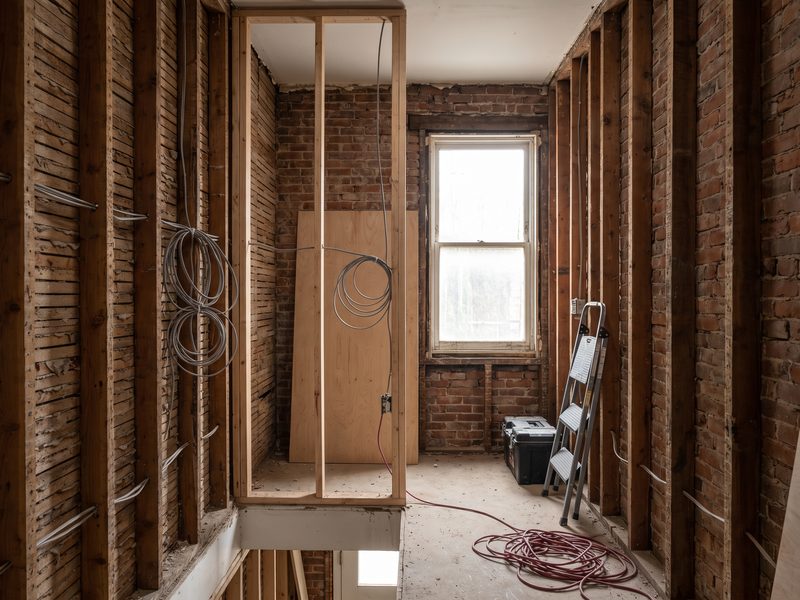
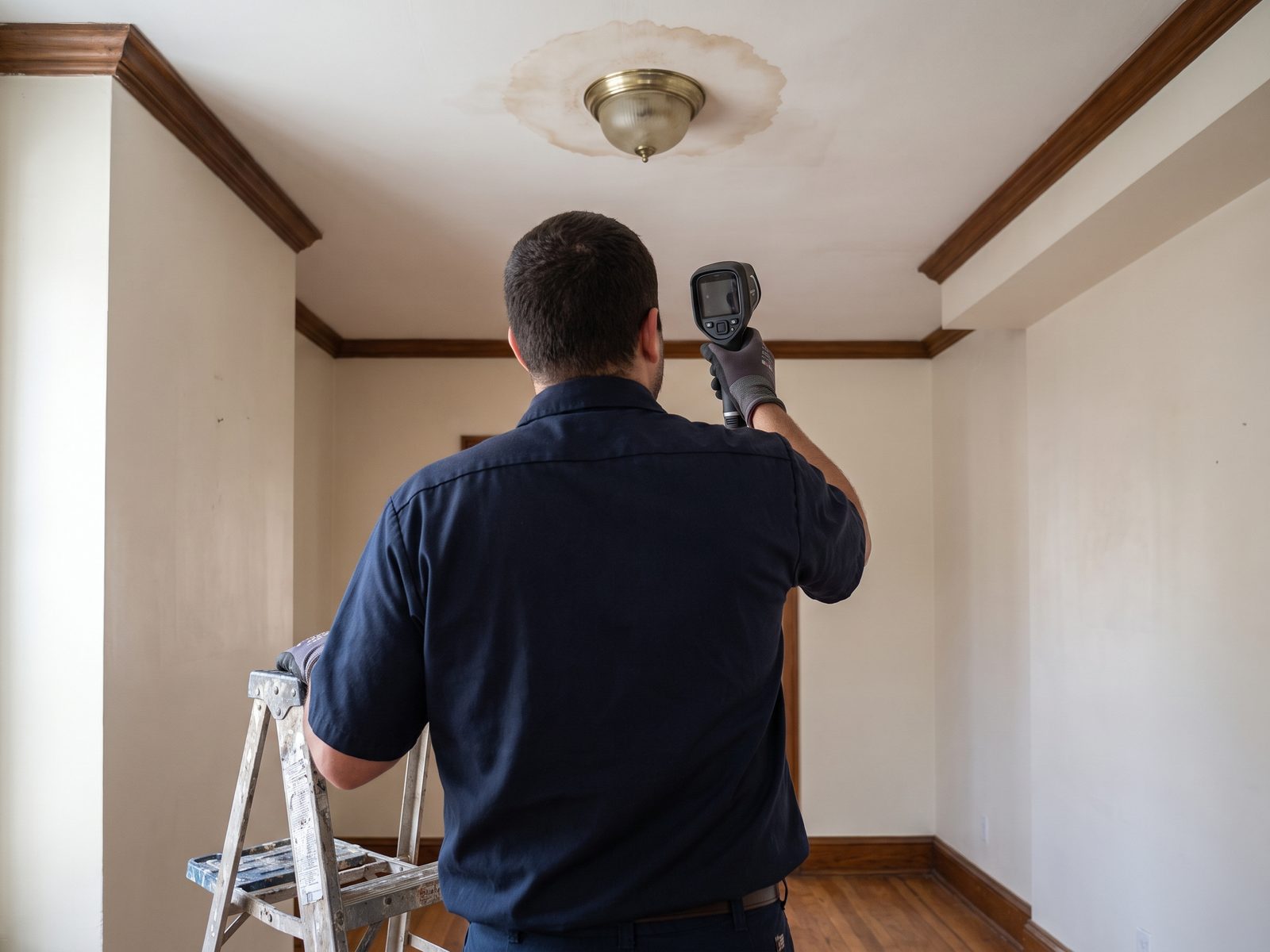
The classic call comes the week the heat first runs. The boiler sits in an unconditioned English basement, the risers climb inside plaster walls, and the first sign is a brown ring on a ceiling two floors up rather than a puddle at the boiler.
What actually leaks: the four failure points in an old radiator system
A hydronic or steam system fails in four places, and each one soaks a different part of the house. The failure points are the radiator valve, the air vent or bleeder, the riser and return piping, then the boiler.
The valve at the foot of the radiator is the most common failure. It is a packed joint that gets bumped by furniture and cranked shut by tenants who find the room too hot. Packing dries out and the stem weeps. It is rarely dramatic, which is the problem. A slow weep under a cast-iron radiator wicks into the floor for weeks before the finish lifts.
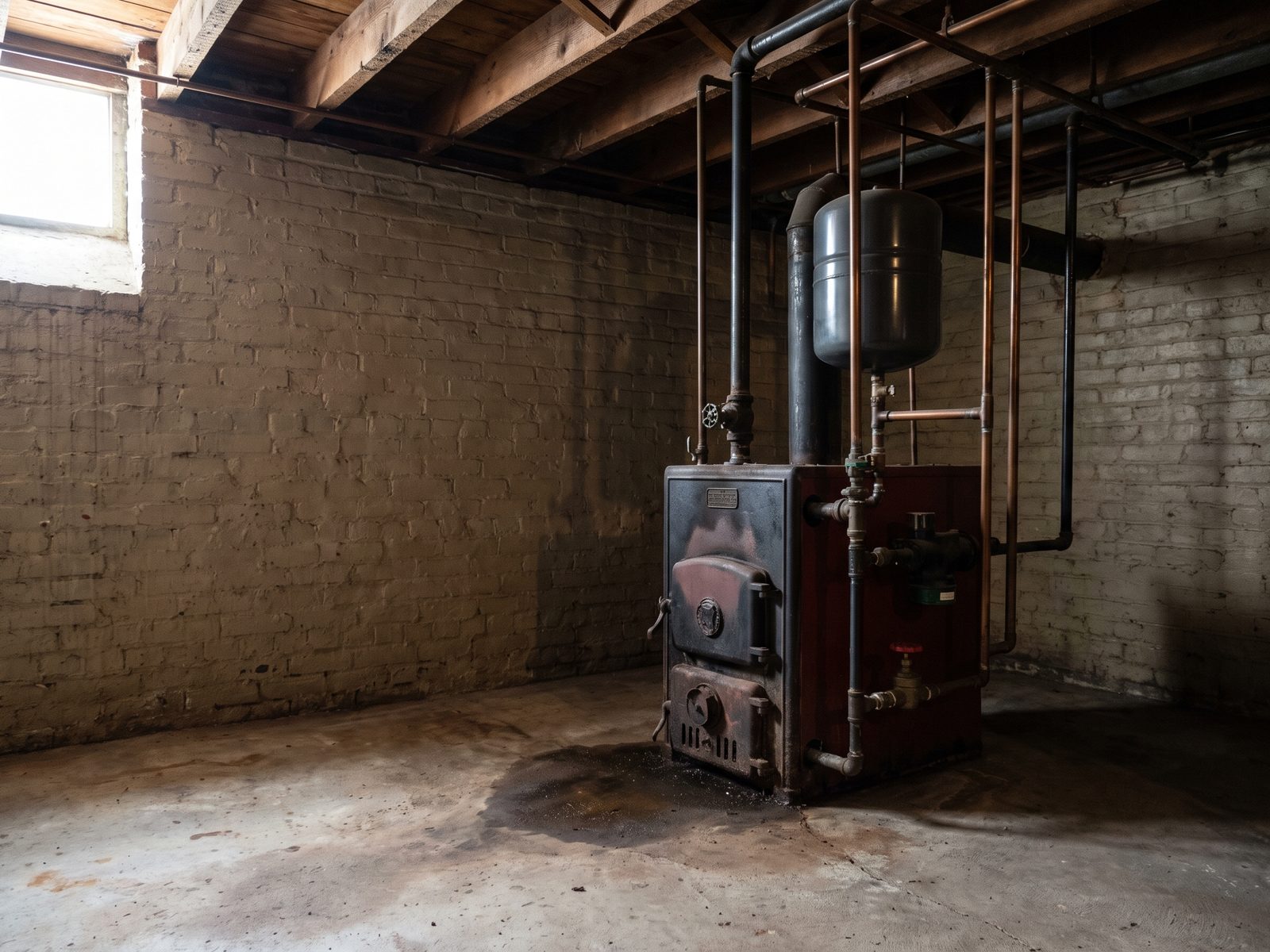
The riser does the real structural damage. A pinhole inside a party wall has nowhere to go but into lath and the joist bay behind it. Boiler failures are easier to spot because they land on a basement slab, though the relief valve, expansion tank, circulator flange and automatic fill can all put real volume on the floor unnoticed.
| Failure point | What you notice | What it soaks first | Who fixes the source |
|---|---|---|---|
| Radiator supply or shutoff valve | Rust-colored weep at the stem, crusted mineral ring, warped floor finish at one radiator | Floor finish and subfloor, then the joist bay under the radiator | Licensed heating contractor or plumber |
| Air vent (steam) or bleeder valve (hydronic) | Spitting or hissing at the vent, spray pattern on the wall behind the radiator, stained paint | Plaster wall behind the radiator, the baseboard, then the cavity | Licensed heating contractor |
| Riser or return pipe inside a wall or floor | No visible source, a ceiling stain one or two floors down, a warm damp smell with the heat running | Wall cavity, lath, joist ends, and the ceiling below the run | Licensed heating contractor, often after a leak-detection scan |
| Boiler, relief valve, expansion tank or fill line | Damp or stained slab under the unit, dripping at a fitting, sediment on the floor | Basement slab, stored contents, finished basement walls, adjacent framing | Licensed heating contractor |
How do you tell a radiator leak from a supply-line leak or a roof leak?
Timing is the strongest clue. A heating leak tracks the heating cycle. It appears or worsens when the system fires, it may stop when the house coasts, and it goes quiet in April when the boiler shuts down for the year. Domestic supply plumbing does not care what the thermostat is doing.
Rain is the second clue. A flat-roof or parapet leak follows weather, not the thermostat, and it usually shows at an outside wall or near a roof penetration. If the stain grows on a dry cold night with the heat cycling, the roof is not your problem.
Water character helps once you can see it. Closed-loop hydronic water is not fresh water. It has circulated through steel and iron for years, so it carries rust and whatever treatment chemical was last added, which is why the stain reads orange-brown rather than clear.
- Only with the heat on, stops when the system rests: radiator, vent, riser or boiler
- Constant, day or night, regardless of season: domestic supply line, fixture or appliance
- Follows rainfall, worse at an outside wall or a roof penetration: roof, parapet or flashing
- Worst in humid weather, no plumbing above, efflorescence on masonry: foundation seepage
- Orange-brown staining with a metallic smell while the heat runs: loop or condensate water
Why does the stain show up two floors below the leak in a row house?
Because water in a row house travels sideways and down long before it comes through a finish surface. Risers run vertically inside party walls and interior partitions, and a pinhole drops water into a cavity that is effectively a chimney of open framing. The water lands on the nearest joist or run of lath, then follows it until it finds a hole.
The holes it finds are almost always fixtures. A ceiling light box, a recessed can or an old gas-line penetration gives the water its first exit into a room. That is why these calls start the same way: a brown ring around a light fixture in the back bedroom, with no bathroom above it.
This is where people damage their own claim. They cut plaster to chase the water. In a house with three-coat plaster over wood lath, that exploratory demolition costs more than the leak did, and it usually misses, because the wet plaster you can see is where the water left the cavity. Moisture mapping with a meter, a thermal camera and a few deliberate inspection holes finds the run far more reliably.
What should you do in the first ten minutes, and what should you not touch?
Turn the heat off at the thermostat, then shut the boiler down at its service switch, normally a red-plated toggle at the top of the basement stairs or beside the unit. Stopping the burner stops the pressure pushing water through the failure. If the leak is at one radiator and its shutoff valve turns freely by hand, closing it is reasonable. If it is seized, painted over or hot, leave it alone.
Then stop. Do not bleed a radiator, adjust pressure, open the fill valve or add water to a system you are not trained on. A boiler is a pressure vessel and the surfaces around it get hot enough to burn. The source repair belongs to a licensed heating contractor. Restoration Doctor does not service, repair or replace boilers or heating systems.
While you wait, protect what is still dry. Get contents off wet floors and put foil or wood blocks under furniture legs. Pull the rugs. If what you have is a burst pipe rather than a slow heating leak, our sister site restorationdoctors.com covers that response at https://restorationdoctors.com/blog/frozen-pipe-burst-what-to-do, where the clock runs a great deal faster than it does here.
- Heat off at the thermostat, then the boiler off at its service switch
- Close the individual radiator valve only if it turns easily and is not hot
- No bleeding, no pressure adjustment, no refilling the system yourself
- Photograph the stain, the radiator, the ceiling below and the boiler area first
- Cut power at the panel to any circuit feeding a wet ceiling fixture
- Call a licensed heating contractor for the source, a restoration contractor for the water
Is radiator water clean water? How the category is decided
There is no blanket answer, and anyone who gives you one without looking at the loss is guessing. Under the ANSI/IICRC S500 standard, water losses are sorted into three categories by how contaminated the water is. Category 1 is water from a sanitary source, Category 2 carries enough contamination to cause discomfort or illness, and Category 3 is grossly contaminated. A restorer assigns the category on site.
Water from a closed heating loop starts cleaner than people expect, because it is not sewage and it is not groundwater. It is also not drinking water. It has cycled through iron and steel for years, so it carries rust and scale, and many older systems have had inhibitor or antifreeze added.
What moves the category is time and what the water touched. Loop water that has run down through a plaster cavity, over old lath and into carpet on a lower floor is not the water it was at the pinhole. The category drives what gets dried and what gets removed, so it is worth getting right rather than assuming.
- Source: closed-loop water and condensate are neither sanitary supply water nor sewage
- Path: water crossing old lath and construction dust picks up contamination on the way
- Time: a category can degrade as hours turn into days in a warm house with the heat running
- The assessment is made on site and written into the file, never assumed from the system type
What does hot-water leakage do to plaster, lath and heart-pine floors?
Warm water is harder on old materials than cold water. It moves into porous surfaces faster and speeds up everything that follows, including microbial growth. In a row house the materials taking that hit are three-coat plaster over wood lath, softwood subfloor, and a finished floor of heart pine or narrow oak.
Plaster fails at the keys first. The brown coat pushes through the gaps between lath strips and hooks over the back, and those hooks hold the ceiling up. Saturated lath swells, the keys snap, and a ceiling that looks sound from below is hanging on very little. A ceiling that feels spongy or shows a sag is a safety issue, not a cosmetic one.
Floors telegraph the damage more slowly. Heart pine absorbs from the underside as readily as the top, so a board that takes on moisture from below cups, then crowns as it dries unevenly. The fastest way to lose an original floor is to dry the room air aggressively while the subfloor is still wet.
Does homeowners insurance cover a radiator or boiler leak?
Most homeowners policies respond to water damage that is sudden and accidental, and many carriers treat a radiator valve letting go or a riser splitting as exactly that. What policies generally exclude is the gradual version: seepage over weeks, and corrosion or wear that finally let go. A heating leak can be both at once, which is why documentation of when it started carries weight.
There is a second split. The damage the water does to your ceilings and floors is one thing. Repair of the boiler, valve or pipe that failed is usually another, and it is commonly excluded as the failed part itself. Read the water-damage language on your own declarations page rather than what a neighbor's carrier did.
A condo, co-op or English-basement rental adds a third layer, because the boiler may serve more than one unit or the leaking riser may sit in a wall the association owns. If a property has sat empty over the winter, check the vacancy language too. The District's Department of Insurance, Securities and Banking regulates D.C. policies and handles consumer complaints.
- Usually considered: a sudden valve, riser or fitting failure and the resulting building damage
- Usually excluded: long-term seepage, corrosion or wear, and the failed component itself
- Check separately: vacancy and unoccupancy clauses, and any cap on water damage
- Keep: timestamped photos, the heating contractor's diagnosis, and daily moisture readings
What does professional drying look like when the walls are plaster, not drywall?
It looks slower and far less destructive than the drywall version. Drywall gets cut out at a flood line because it is cheap to replace and holds water badly. Three-coat plaster over lath is neither. It is expensive to match, often original to the house, and much of it can be saved. So the first move is measurement rather than demolition.
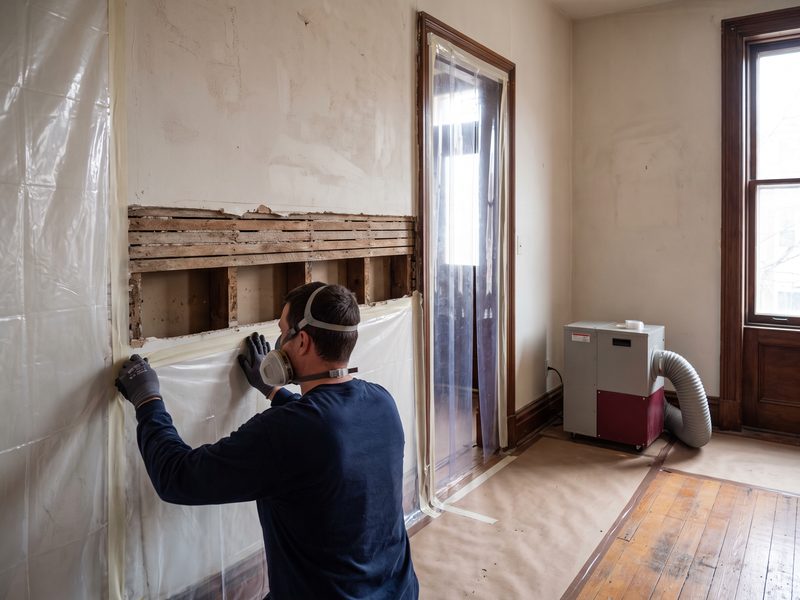
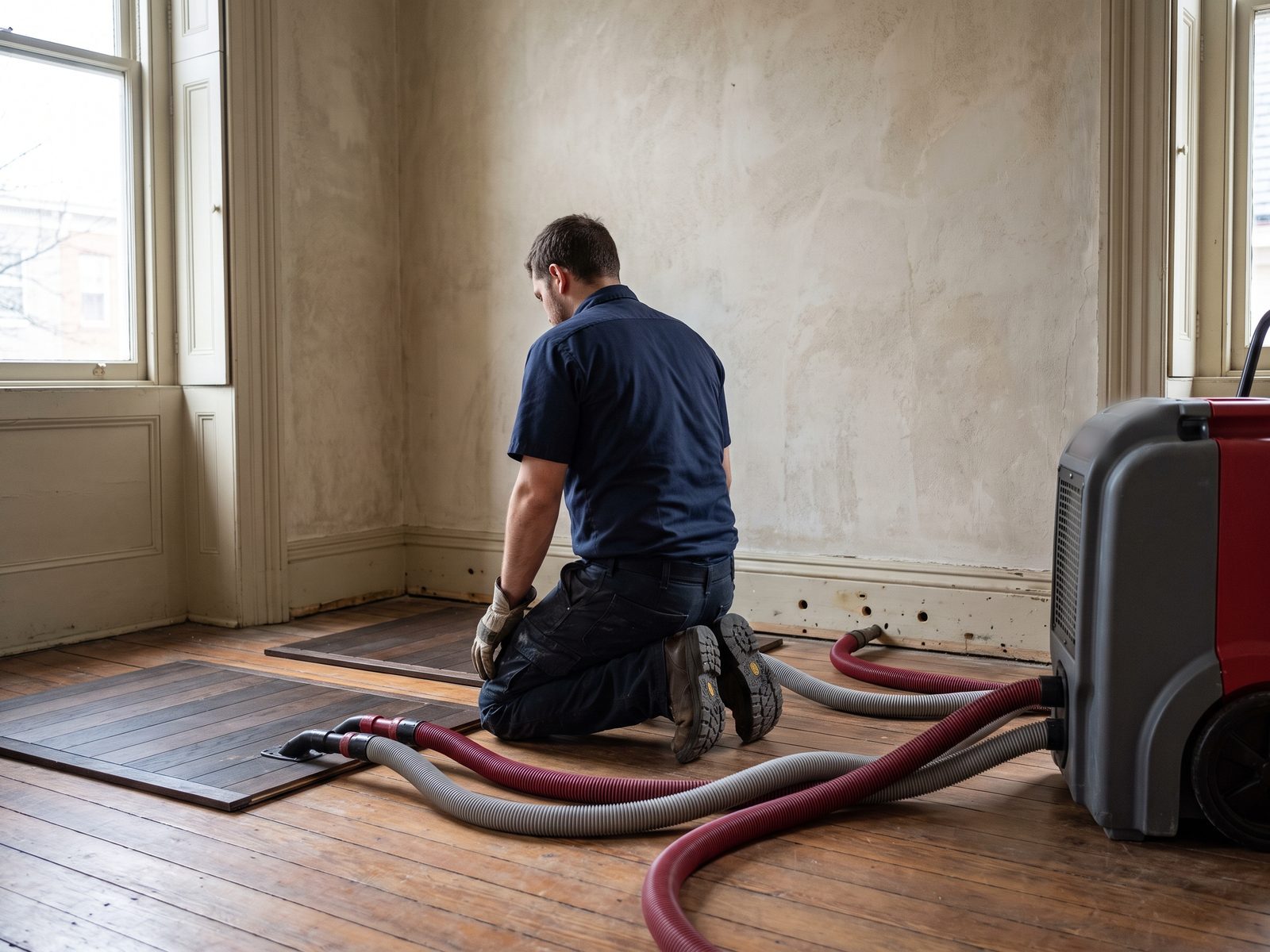
Mapping comes first: a non-penetrating meter across the suspect area, pin readings where a hole is acceptable, thermal imaging to find wet edges the eye misses, and a documented boundary of what is actually wet. The cavity is then dried from the least visible side, usually through small holes behind a removed baseboard, so the face of the plaster stays intact.
Floors get their own approach. Drying mats or a panel system pull moisture up through a hardwood floor from the finish side, slow work measured in days. Readings get taken at the same points every day and written into the file, so there is a defensible stopping point rather than a guess.
How do you get through a DC heating season without a repeat?
Start the system before you need it. A test run in early October, while the weather is forgiving, turns a January emergency into a service call you can schedule. Fire the heat, let every radiator come up, then walk the house with a flashlight and a dry paper towel, touching the base of each valve and the floor around each radiator.
Pay attention to the boiler room. An English basement that stays cold and damp hides evidence, so keep the slab under the unit clear enough to see and keep stored contents off the floor. If the automatic fill is topping the system up regularly, the system is losing water somewhere, and that is a question for a heating contractor.
Know where the boiler service switch is before you need it in the dark. Check the ceilings under known riser runs once a month, because a stain the size of a coaster is a different job from one the size of a dinner plate.
- Run the heat once in early October and inspect every radiator base with a dry towel
- Treat a fill valve that runs often as a leak somewhere in the system, not a quirk
- Learn the location of the boiler service switch and the main water shutoff now
- Sources: ANSI/IICRC S500, the water damage restoration standard: https://iicrc.org/s500/
- Sources: EPA, A Brief Guide to Mold, Moisture and Your Home: https://www.epa.gov/mold/brief-guide-mold-moisture-and-your-home
- Sources: D.C. Department of Insurance, Securities and Banking: https://disb.dc.gov/
- Sources: IICRC S500 consensus body position statement on water category: https://iicrc.org/wp-content/uploads/2026/04/Weather-Related-Position-Statement_2026.pdf