
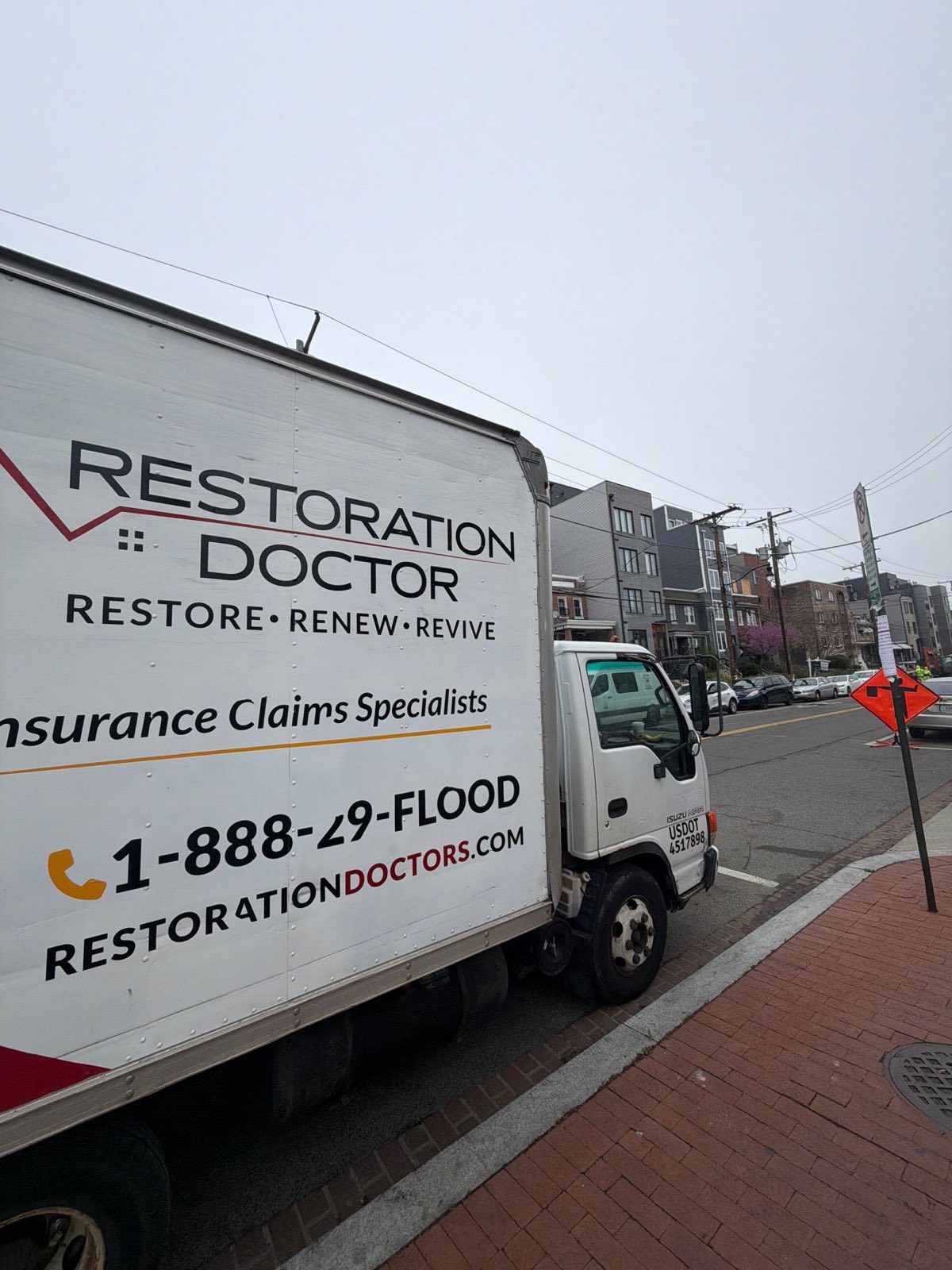
Water Damage Restoration in Camp Springs, MD
Water damage restoration in Camp Springs, MD is the work of a Joint Base Andrews community — a Prince George's County suburb of split-foyers, colonials, and ramblers that grew up around the base from the 1960s through the 1980s. These are family homes on real lots, and like most of the county they carry their living space downward, into full basements that were long ago finished into rec rooms, bedrooms, and offices. Restoration Doctor answers Camp Springs emergencies around the clock, because that below-grade space is the first place a water loss lands and the hardest place to dry once it is soaked.
The water that reaches those basements comes from three directions, and every Camp Springs loss is really about figuring out which one. There is the failure from inside — a water heater, a supply line, an appliance that lets go and sends water down through the house. There is the pressure from outside — a fast summer thunderstorm that saturates the ground and pushes groundwater through the foundation when a sump cannot keep up. And there is the failure from below — an aging WSSC sewer lateral that clogs or surcharges and backs contaminated water up through a basement drain.
Whether you own a split-foyer off Allentown Road, a colonial in a 1970s subdivision, or a rambler near the base fence line, the response is the same in every case: stop the source, extract fast, dry to a verified moisture standard, and document every reading so the insurance claim is built on evidence rather than argument. Here is how each of those three paths plays out in Camp Springs homes and what we do about them.
How water damage behaves in Camp Springs
From a failed water heater to a soaked lower level
The most common Camp Springs loss starts with an interior failure and ends in the basement. A water heater at the end of its life gives way, a supply line bursts, or a washing-machine hose lets go, and gravity carries the water down through the joist bays and finished levels to the lowest point in the house. In a finished basement, it saturates carpet pad, wicks up into drywall, and soaks the bottom plates of framed walls, often spreading well past the visible stain before anyone notices.
We trace the true footprint with thermal imaging and moisture meters rather than the visible damage, then dry cavities and assemblies in place wherever the readings allow. Our licensed in-house plumbing team repairs the line that actually failed, so the drying and the fix happen together and the same failure does not return. Preserving a finished lower level by drying it, instead of gutting it, is exactly what keeps a manageable Camp Springs loss from becoming a full renovation.
From a summer downpour to groundwater seepage
Camp Springs summers bring hard, fast thunderstorms, and the older foundations here were not built for the runoff a modern one can produce in an hour. When the ground saturates, hydrostatic pressure builds against below-grade walls, and a home whose sump is undersized, worn out, or running on a dead backup battery lets groundwater seep in through cracks, the cove joint, and around the slab into the finished basement.
Groundwater that has moved through soil is Category 2 water, not clean, so we treat storm seepage accordingly: extraction, selective removal of unsalvageable porous materials, antimicrobial treatment, and drying to a verified standard. We map the wet area with moisture meters and thermal imaging so we catch the water that traveled behind finished walls — the hidden, undried moisture that is the leading cause of the mold we later find in Camp Springs basements. Where growth already exists, we remediate it under IICRC S520 with containment.
From an aging lateral to a Category 3 backup
Much of Camp Springs runs on WSSC sewer laterals that have been underground for decades, and age catches up with them. Roots, grease, and cracks clog and collapse those lines, and when a lateral backs up — or the system surcharges during a heavy storm — wastewater pushes up through the lowest fixture in the house, usually a basement floor drain, laundry standpipe, or toilet.
What surfaces is Category 3 sewage: contaminated, hazardous, and impossible to sanitize back into safe living space by drying alone. We handle it as a biohazard — extract the contaminated water, remove and bag porous materials that cannot be disinfected, clean and apply antimicrobial treatment to every surface that stays, and only then set structural drying to a verified standard. Our in-house plumbers can clear or repair the failed lateral so the backup does not return the week after we leave.
Camp Springs housing stock and how it fails
Camp Springs took its shape from Joint Base Andrews. As the base anchored the area, developers filled the surrounding land through the 1960s, 70s, and 80s with the era's suburban staples — split-foyers, split-levels, brick and frame colonials, and ramblers on comfortable lots. They are solid, roomy homes with garages and yards, and nearly all of them sit on full basements that families finished into everyday living space with drywall, carpet, and belongings that hold water and grow mold quickly once wet.
Because so much of the community dates to the same two decades, Camp Springs homes tend to share their strengths and their weak points. The construction is durable, but the supply lines, water heaters, and drain runs are now old enough to be reaching the end of their service lives, and the foundations predate modern waterproofing. Much of the area is on the WSSC system, so the sewer laterals connecting these houses to the main have been in the ground for decades. That shared vintage means a single failure mode — a tired water heater, a clogged lateral, an overwhelmed sump — tends to repeat from house to house, which is why we treat every Camp Springs loss as both a drying job and a chance to flag the cause.
Areas of Camp Springs we serve
Real Camp Springs blocks and buildings — and the water losses we most often see in each.
1960s-80s split-foyers and colonials where finished basements collect water at the low point of the house.
Older single-family homes on aging WSSC laterals prone to Category 3 sewage backups.
Suburban ramblers and split-levels near the base with era-appropriate supply lines prone to interior failures.
Established homes on sump systems that struggle during fast summer thunderstorms.
Split-levels on rolling terrain where hydrostatic pressure pushes groundwater into below-grade space.
Mid-era homes with aging drain runs where clogged laterals surcharge into basement floor drains.
Documented project files
Real CompanyCam-documented Restoration Doctor work in the Washington, DC metro — every project photographed with date and time stamps.
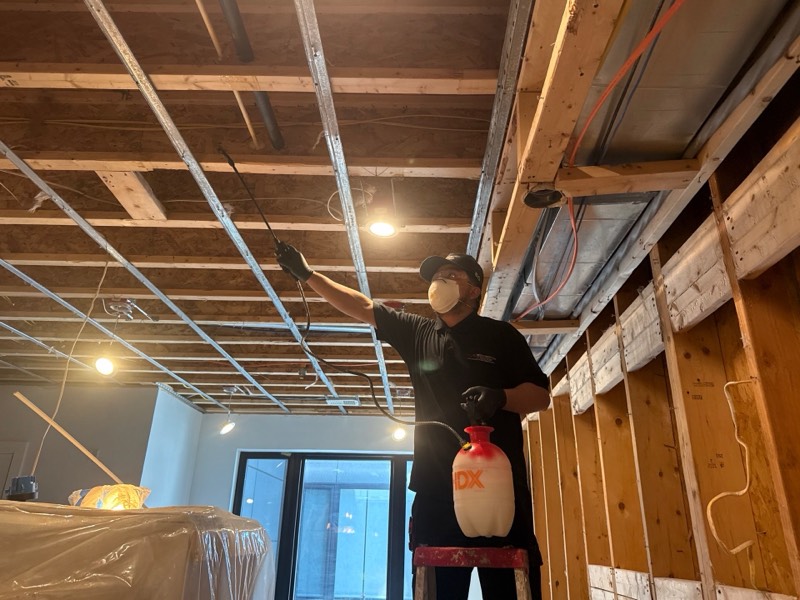
Moisture mapping & structural drying — documented Washington, DC project
A documented Washington, DC loss where crews mapped the hidden wet footprint with thermal imaging and moisture meters, then dried the structure in place and verified it to a dry standard — the diagnostic approach we bring to Camp Springs basements.
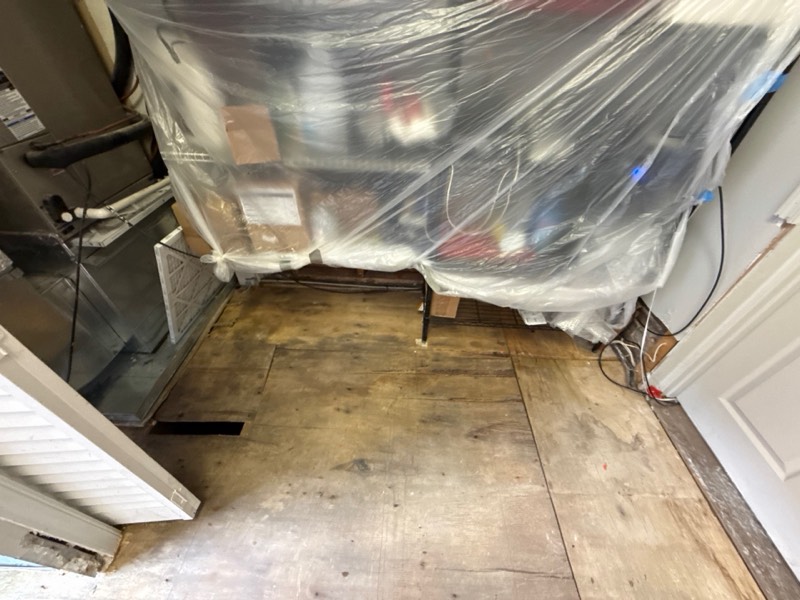
Emergency water extraction & dry-out — documented Washington, DC project
A documented Washington, DC emergency carried from rapid extraction through monitored dry-out, with drying equipment staged to the wet footprint and verified to a dry standard — the fast-response method we apply to Camp Springs losses.
Full restoration services in Camp Springs
One operation covers every category — from emergency mitigation to full reconstruction.
Water Damage Restoration
Extraction, structural drying, and moisture verification for pipe breaks, appliance leaks, and English-basement flooding across the District.
Sewage & Biohazard Cleanup
Category 3 black-water decontamination with full PPE, contaminated-waste removal, antimicrobial treatment, and verified drying after sewer backups and overflows.
Mold Remediation
IICRC S520 containment, HEPA filtration, safe source-based removal, and independent post-remediation clearance verification.
Fire & Smoke Damage Restoration
Soot and smoke-residue removal, source-based odor neutralization, contents pack-out, and preservation-sensitive reconstruction after a fire — performed to ANSI/IICRC S700, the fire and smoke damage restoration standard.
Storm Damage Restoration
Emergency tarping, water extraction, and reconstruction after wind, heavy rain, and the flash flooding DC's summer storms produce.
Reconstruction & Repairs
Drywall, plaster, flooring, cabinetry, trim, and paint — the same in-house crew that dried the loss rebuilds it, with no handoff and preservation-sensitive finish matching for District homes.
What Camp Springs homeowners look for
In a steady, family-oriented community like Camp Springs, the qualities worth vetting in a restoration company are practical ones: does the crew show up fast, does it know how to handle a sewage backup safely, and does it document the loss honestly enough that a claim stands on its own. Homeowners here are protecting real living space in those finished basements, and they want the water gone, the lower level safe, and a paper trail that works with their carrier rather than against them.
You will not find review counts or star ratings printed on this page. Our verified customer feedback lives on a separate reputation hub instead: visit RestorationDoctorsReviews.com to read the reviews and see the genuine Google aggregate for yourself, then come back here to schedule service for your Camp Springs home. We keep the numbers on a source-linked hub rather than typing them onto a marketing page on purpose — the figures there are the real Google totals, not something we invented.
Frequently asked
Active water, mold, fire, or sewage event?
Connect directly with the Restoration Doctor team for your region. Crews are on standby 24/7 with documented response protocols.