
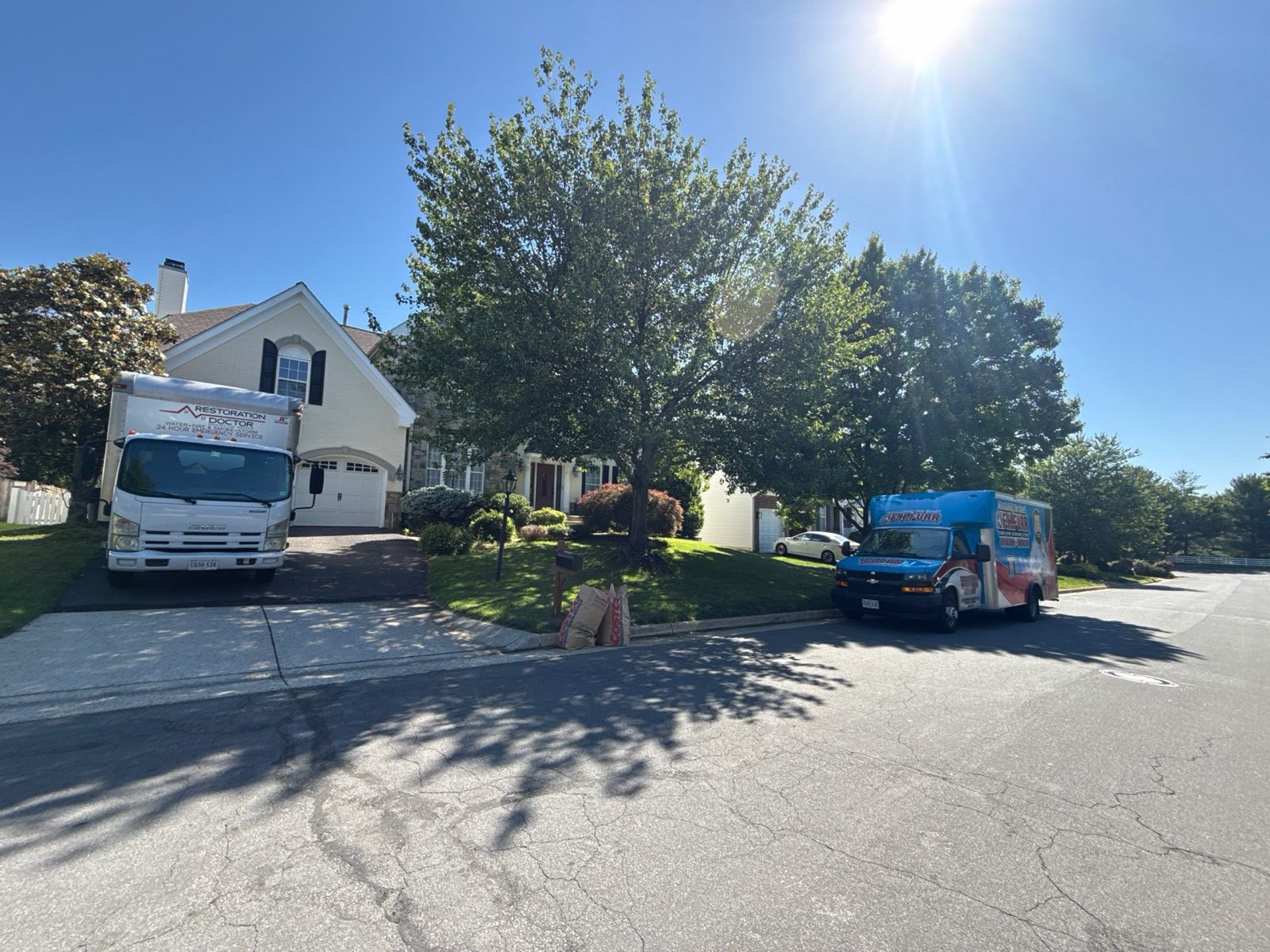
24/7 Emergency Restoration Company in Washington, DC
Restoration Doctor of Washington DC is a 24/7 emergency restoration company: call 202-922-1444 at any hour, and a crew is typically on-site within 60 minutes anywhere in the District.
Restoration Doctor of Washington DC dispatches crews 24 hours a day, 7 days a week, and in most cases a crew is on-site within 60 minutes of your call anywhere in Washington, DC.
Restoration Doctor handles the property emergencies in Washington, DC that cannot wait for morning: burst supply lines, flooded English basements, sewage backups out of the District's combined sewers, fire and smoke damage, storm water through a failed roof, and the mold that follows water nobody dried.
Restoration Doctor of Washington DC works in the District under DC Basic Business License #410524000721, held by VA Water Damage LLC dba Restoration Doctor in the General Contractor / Construction Manager category, issued by the DC Dept. of Licensing & Consumer Protection, and its crews work to the ANSI/IICRC S500, S520 and S700 standards on every Washington, DC loss.
An emergency call is not a sales enquiry, and this page is written on that assumption. If water is running right now, stop reading and call 202-922-1444: a person answers, at any hour, and the first thing they will do is help you find the shutoff. Everything below is for the version where the water is off and you have ten minutes to choose who to let into your house.
Response time is the one thing about a restoration contractor that cannot be improved after the fact. Water migrates through wall cavities for every hour it sits, and under IICRC S500 clean water begins degrading toward Category 2 in roughly 48 hours. The line between drying a room in place and demolishing it is measured in hours. Our trucks stage inside the metro rather than an outer-suburb yard, which is why an hour is a normal arrival here and not a slogan.
What happens, from the moment you call
Here is what actually happens, on the clock, from the moment the phone rings. These are typical timings for a District address. A crew already committed to another loss at three in the morning can run longer, which is why this page says typically and means it.
- Minute 0
A person answers
Not a voicemail box and not an answering service taking a message for the morning. We take the address, the source if you know it, whether the water is clean, gray, or sewage, whether power is safe, and where your shutoff is. If the source is still running we talk you through stopping it before anyone is dispatched.
- Within 60 minutes
A crew reaches the address
Trucks stage inside the metro, not an hour outside the Beltway, so a two in the morning call from Petworth, Capitol Hill, or the Southwest Waterfront gets an inside-the-city response. Overnight and weekend calls run on the same equipment and the same documentation as a Tuesday morning. If every crew is already committed, dispatch tells you the real arrival time on the phone.
- First hour on site
Source control and safety
Stop or isolate the water, de-energize affected circuits where that is needed, and clear immediate hazards before any other work starts. On a sewage backup the affected area is contained first, because a Category 3 event is a health problem before it is a building problem.
- Hours one to four
Scope, moisture map, extraction
Thermal imaging plus penetrating and non-penetrating meters, room by room, to find where the water actually went — nearly always further than the visible stain, because it runs down and sideways through wall cavities. Standing water comes out, saturated carpet and pad are handled, and contents at risk are blocked up off wet floors or packed out and inventoried.
- First 24 hours
Drying equipment on a calculated plan
Air mover and dehumidifier counts come from the affected area, the class of loss, and the psychrometric conditions in the space, not from whatever was left on the truck. Containment goes up where it will speed drying or protect rooms that are still dry. From here every reading, room, and piece of equipment is photographed and logged.
- Day 2 to day 3
Daily monitoring to a dry standard
A technician returns each day, records readings for every monitored material, repositions equipment, and logs it. Most dry-outs run a few days to about a week. Equipment comes out when materials reach the dry standard verified by meter, not when the calendar hits three days; saturated plaster, hardwood, or below-grade masonry takes longer.
- After the structure is dry
The file, and the rebuild
You receive the documentation package and a line-item Xactimate estimate: time-stamped photographs of each phase, daily moisture and psychrometric logs, an equipment record, and a written scope narrative. If reconstruction is needed it is scoped inside the same file, so nothing falls into the gap that opens when mitigation and repairs are split between two companies.
Emergencies we respond to
These are the calls that come in at night, in the words people actually use. Each links to the full method page.
Emergency water extraction and structural drying
Standing water out first, then a drying plan calculated from the affected area and run to IICRC S500, verified by meter.
Flooded basement cleanup
English basements and below-grade units that take water through a silted areaway drain, a failed sump, or the wall-and-slab joint.
Sewage backup cleanup
Category 3 decontamination after a combined-sewer surcharge or a failed lateral: containment, full PPE, antimicrobial treatment, and verification.
Fire and smoke damage mitigation
Soot and smoke residue removal and source-based odor neutralization to IICRC S700, plus the suppression water the fire department leaves behind.
Storm damage, board-up and tarping
Emergency board-up and tarping, wind-driven rain intrusion, and cleanup after the squall lines that run up the Potomac.
Mold remediation
IICRC S520 containment, negative air, HEPA filtration, and post-remediation verification.
Reconstruction and repairs
Drywall, plaster, trim, flooring, paint, and cabinetry, estimated in the same line-item file as the mitigation.
What to do before the truck arrives
None of this needs tools and none of it is worth getting hurt over. If a step would mean standing in water near live electrics, skip it and tell the crew.
- 1
Stop the water at its source
Fixture shutoff first, then the building main if the fixture valve will not hold. In most DC rowhouses the main is in the basement near the front wall where the service enters; in a condo it is usually behind a utility access panel, and building management can find it fastest.
- 2
Cut power to the affected area only if the panel is dry
If reaching the breaker would mean standing in water, do not. Say so on the phone and the crew handles it on arrival.
- 3
Get people and pets out of the wet area
This matters most on a sewage backup, where the water is a health hazard, and on any loss where a ceiling has started to sag.
- 4
Lift what you can, photograph what you cannot
Move rugs, electronics, boxes, and anything made of paper or fabric off the floor. Photograph each room before anything is moved: those pictures are the only record of the loss at its worst, and they belong in your claim file.
- 5
Tell the neighbor on the other side of the party wall
In an attached rowhouse, water travels through the shared masonry and along the joist pockets into the house next door. That is a day-one conversation, not one to have after mold appears.
- 6
Do not start cutting drywall
Emergency stabilization should begin immediately; demolition scope belongs on paper first. A verbal promise to see what we find is how a two-room loss becomes a tear-out nobody authorized.
Where we respond
We dispatch to all four quadrants of the District, every night of the year, and then to close-in Maryland. The building type changes quadrant to quadrant and so does the failure mode, which is why a Georgetown rowhouse and a Navy Yard high-rise unit get different scopes even when the water came from the same fitting.
Northwest Washington, DC
The oldest and densest housing stock in the city, plus every block draining toward Rock Creek: plaster over lath, converted flats, and 1920s co-ops where one failed riser runs down four floors.
Georgetown, Dupont Circle, Adams Morgan, Logan Circle, Foggy Bottom, Kalorama, Mount Pleasant, Columbia Heights, Petworth, Cleveland Park, Woodley Park, Glover Park, Tenleytown, Friendship Heights, Palisades, Brightwood, Shepherd Park
Northeast Washington, DC
Brick rowhouses and bungalows alongside newer condo construction on the Red Line. Older clay laterals make sewer backups a recurring event rather than a one-off, especially after heavy summer rain.
Brookland, NoMa, Eckington, Trinidad, Ivy City, Langdon, Woodridge, Michigan Park, Riggs Park, Fort Lincoln, Kingman Park, Deanwood
Southeast Washington, DC
Historic Capitol Hill rowhouses with shared party walls and cellar-level kitchens, plus the Navy Yard corridor where one unit loss becomes a stack loss.
Capitol Hill, Navy Yard, Barney Circle, Hill East, Anacostia, Fairlawn, Hillcrest, Penn Branch, Randle Highlands, Congress Heights
Southwest Washington, DC
Mid-century co-ops and towers beside new waterfront construction, sitting low against the Washington Channel, where below-grade parking takes water first and the building's pumps decide how bad it gets.
Southwest Waterfront, The Wharf, Buzzard Point, Fort McNair area, L'Enfant Plaza
Montgomery County, Maryland
Prince George's County, Maryland
Beyond the District the same crews cover close-in Montgomery County and Prince George's County, Maryland. Anything inside or just outside the Beltway is a normal dispatch on the same 24/7 rota as a District address.
How to check us before you let anyone in
Three things about a restoration contractor are checkable before you let anyone into the house at two in the morning: the rating, the license, and the standard the crew works to. Check them on us, and on whoever else has a truck at your curb.
The rating on this page is pulled live from our Google Business Profile for the Washington DC listing rather than typed onto the page, critical reviews included. When that feed is unreachable the page shows no number at all, because a rating you cannot reconcile against its listing is not proof of anything.
The license number is public and you should verify it yourself through the issuing authority rather than trusting a number painted on a truck door. A company licensed only in Maryland or Virginia is not licensed to do your DC job.
A technician who cannot name the standard governing the job in front of them is not going to document to it. Ours work to ANSI/IICRC S500 for water, S520 for mold, and S700 for fire and smoke.
Restoration Doctor of Washington DC works in the District under DC Basic Business License #410524000721, held by VA Water Damage LLC dba Restoration Doctor in the General Contractor / Construction Manager category, issued by the DC Dept. of Licensing & Consumer Protection, and its crews work to the ANSI/IICRC S500, S520 and S700 standards on every Washington, DC loss.
What people ask at two in the morning
- How fast can you get to my address in an emergency?
- Restoration Doctor of Washington DC dispatches crews 24 hours a day, 7 days a week, and in most cases a crew is on-site within 60 minutes of your call anywhere in Washington, DC. Trucks stage inside the metro rather than an hour outside the Beltway, so a two in the morning call gets the same response as a weekday one.
- Are you open right now?
- Yes — Restoration Doctor of Washington DC answers the emergency line 24 hours a day, 7 days a week, including nights, weekends, and holidays, anywhere in Washington, DC. There is no after-hours voicemail: call 202-922-1444, a person picks up, and a crew mobilizes from there.
- What should I do before your crew arrives?
- Restoration Doctor of Washington DC tells every Washington, DC caller the same things first: shut the water off at its source, cut power to the affected area only if the panel is dry and safe to reach, and get people and pets out of the wet area. Then lift what you can off the floor and photograph each room before anything is moved.
- Do you work with my insurance company?
- Restoration Doctor of Washington DC documents your loss for your carrier, but we do not represent you before it — we are a restoration contractor in Washington, DC, not a public adjuster. You get a carrier-ready file: a line-item Xactimate estimate, time-stamped photographs, daily moisture logs, and an equipment record. We bill the property owner, and the file stays yours.
- What does it cost to have you come out?
- Restoration Doctor of Washington DC quotes a Washington, DC emergency only after a technician has seen the loss, because cost depends on the water category, the area affected, and how long materials stayed wet. You get a written estimate before work begins, as line items rather than a lump sum, so every activity can be checked against what was done.
- Which parts of Washington, DC do you cover?
- Restoration Doctor of Washington DC covers all four quadrants of Washington, DC — Northwest, Northeast, Southeast, and Southwest — including Georgetown, Capitol Hill, Dupont Circle, Logan Circle, Adams Morgan, Navy Yard, NoMa, Petworth, Foggy Bottom, and Anacostia. The same crews cover close-in Montgomery County and Prince George's County, Maryland.
- Are you licensed to work in Washington, DC?
- Yes — Restoration Doctor of Washington DC operates in Washington, DC under DC Basic Business License #410524000721, held by VA Water Damage LLC dba Restoration Doctor in the General Contractor / Construction Manager category. That number is public: verify it through the DC Dept. of Licensing & Consumer Protection rather than trusting a number on a truck door.
If water is still running, call rather than type
The line is answered 24 hours a day by a person who can walk you through the shutoff while a crew is on its way. Use the form only when the emergency is already stopped and you want a callback.
- Crews staged inside the metro, typically on-site within 60 minutes at a District address
- IICRC S500 / S520 / S700 methods with daily moisture logs
- Line-item Xactimate estimate and a carrier-ready claim file you keep
- Dispatch: 202-922-1444 · office@restorationdoctors.com
Active water, mold, fire, or sewage event?
Connect directly with the Restoration Doctor team for your region. Crews are on standby 24/7 with documented response protocols.