
Water Damage Restoration in Takoma Park, MD
For water damage restoration in Takoma Park, MD, from Old Town's frame houses to the Sligo Creek blocks, Restoration Doctor of Washington DC works under Maryland Home Improvement Commission (MHIC) license #167541, held by VA Water Damage LLC dba Restoration Doctor. It answers 24 hours a day at (202) 922-1444.
Updated October 2026
At a glance
- Phone
- (202) 922-1444
- Hours
- 24 hours a day, 7 days a week
- Service area
- Takoma Park, Montgomery County, MD
- Services
- Water damage, sewage cleanup, mold remediation, fire damage, storm damage, reconstruction, extraction & drying, hardwood floor drying, roof tarping, smoke & soot cleaning, contents pack-out
- Maryland license
- MD Home Improvement (MHIC) #167541Held by VA Water Damage LLC dba Restoration Doctor
- DC license
- DC Basic Business License #410524000721Held by VA Water Damage LLC dba Restoration Doctor
- Certification
- IICRC-certified, S500 / S520-aligned
Water damage restoration in Takoma Park, MD, has to fit a place that is unlike the rest of Montgomery County: a tree-covered early-1900s streetcar suburb that sits right on the District line, with Victorian frame houses, bungalows and foursquares on narrow lots, and a stream valley, Sligo Creek, running through it. Restoration Doctor answers Takoma Park emergencies around the clock, because in a house this age a supply-line leak or a backed-up drain reaches plaster, old framing and a basement quickly, and every hour water sits makes the repair bigger.
Takoma Park sits just across the line from the Takoma neighborhood of Northwest DC, and our crews dispatch from Northwest DC, so we know these blocks well as a service area. The neighborhood is known for Old Town near Carroll and Maple Avenues, the Takoma Junction business area, Philadelphia Avenue and the Sligo Creek Parkway corridor, and for a canopy of mature trees. Those trees, the age of the houses and the creek valley are the three things that decide how water behaves here.
Whether you live in a frame house in Old Town, a bungalow off Maple Avenue, a brick colonial near Flower Avenue, or an apartment toward New Hampshire Avenue and Takoma/Langley, the sequence is the same: stop the source, extract the water, dry to a documented moisture standard, and record every reading so you can share it with your insurer. Here is how water actually shows up in Takoma Park, and what to do first.
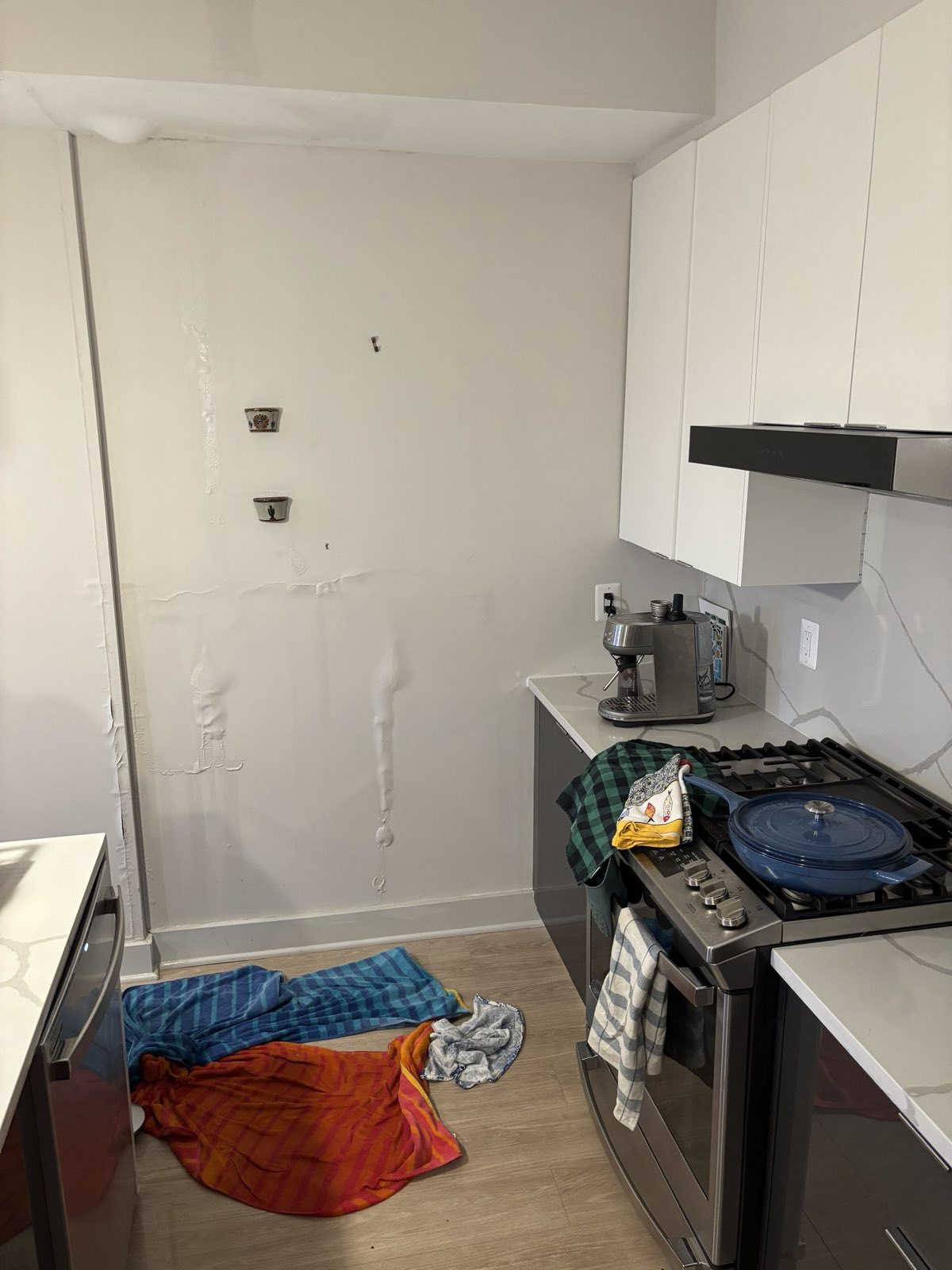
How water damage behaves in Takoma Park
Sligo Creek, Long Branch and stormwater in Takoma Park basements
Takoma Park is cut by the Sligo Creek stream valley and by the Long Branch watershed, and many streets run down toward those valleys. After a hard rain or when the ground is saturated, water follows the slope. Basements low on a block can take on seepage through the foundation, window wells and basement doors, while the same storm may leave a house uphill dry.
We treat water that has crossed the ground and entered a house as Category 2 water, not clean Category 1 water: extraction, removal of materials that cannot be dried or sanitized, antimicrobial treatment and monitored drying. If a basement smells musty a day or two after a storm, or you see damp patches or efflorescence on the wall, call early. Water left in a finished basement grows mold.
Mature trees, old laterals and sewer backups
The tree canopy that makes Takoma Park distinctive also puts roots over and around old sewer laterals. Clay and cast-iron lines from the early and mid twentieth century crack or separate at joints, and roots find them. A slowly failing lateral often shows as slow drains, gurgling fixtures or a sewage smell near the basement floor drain before it backs up completely.
A backup into living space is sewage, Category 3 water and a biohazard. We contain the area, wear full protective equipment, remove porous materials that cannot be disinfected, apply antimicrobial treatment and dry the structure to a documented standard. When the cause is the lateral or a drain line, that repair belongs to a licensed plumber, and we work with licensed plumbers and tell you plainly when you need one.
Old frame, plaster and attics in historic-feeling houses
In a Victorian or bungalow, water rarely stays in one room. A leak from a second-floor bathroom can travel through plaster, down a wall cavity and into a first-floor ceiling, and a roof or porch leak can soak insulation and framing for days before a stain appears. Wet framing that stays wet is where mold gets started.
We map moisture before we open anything, so we can dry cavities in place and cut only what has to come out. Original plaster, trim and hardwood floors that can be dried are worth keeping, and we tell you honestly when a material cannot be saved.
Burst pipes, water heaters and winter freezes
Older houses with exterior-wall plumbing, uninsulated crawl spaces and drafty porches are prone to frozen and split pipes in a Maryland cold snap, and aging water heaters and supply connectors are a steady source of basement floods year-round. When a pipe lets go, shut off the main water valve if you can safely reach it and call us. Fast extraction keeps a plumbing failure from becoming a mold project.
We stop the loss where we can, extract the water, document the cause and the moisture readings, and tell you what a licensed plumber needs to repair. We provide our photos, readings and invoice to you and, at your request, your insurer.
Takoma Park housing stock and how it fails
Takoma Park was laid out in the 1880s as a rail suburb and filled in through the early twentieth century, so its housing is older than most of Montgomery County. Old Town is known for Victorian-era frame houses with deep porches, and the surrounding streets mix Craftsman bungalows, American foursquares and Sears-style kit homes with later brick colonials and small garden apartment buildings. Many have wood framing, plaster-and-lath or older drywall, original or partly replaced plumbing, and basements finished at different times by different people.
That age shapes the loss. Wood framing and plaster hold water and dry slowly, galvanized supply lines corrode from the inside, and cast-iron drains crack and clog over time. A basement may combine a stone or block foundation with later additions, and an attic or porch roof may have been patched more than once. We use thermal imaging and moisture meters to find the real footprint rather than guessing from the visible stain, and we dry in place wherever we can so original trim, floors and plaster are not removed without a reason.
Areas of Takoma Park we serve
Real Takoma Park blocks and buildings — and the water losses we most often see in each.
Victorian-era frame houses and porches around Carroll and Maple Avenues where plaster and old framing hold water.
Mixed-use blocks and nearby houses where a shop or apartment leak can reach the unit below.
Streets sloping toward the stream valley where saturated ground pushes seepage into basements.
Bungalows and foursquares with finished basements and aging supply lines and drains.
Brick colonials and small apartment buildings with basement and shared-wall water losses.
Garden-style apartments and townhomes where a leak in one unit travels to the next.
Documented project files
Real CompanyCam-documented Restoration Doctor work in the Washington, DC metro — every project photographed with date and time stamps.
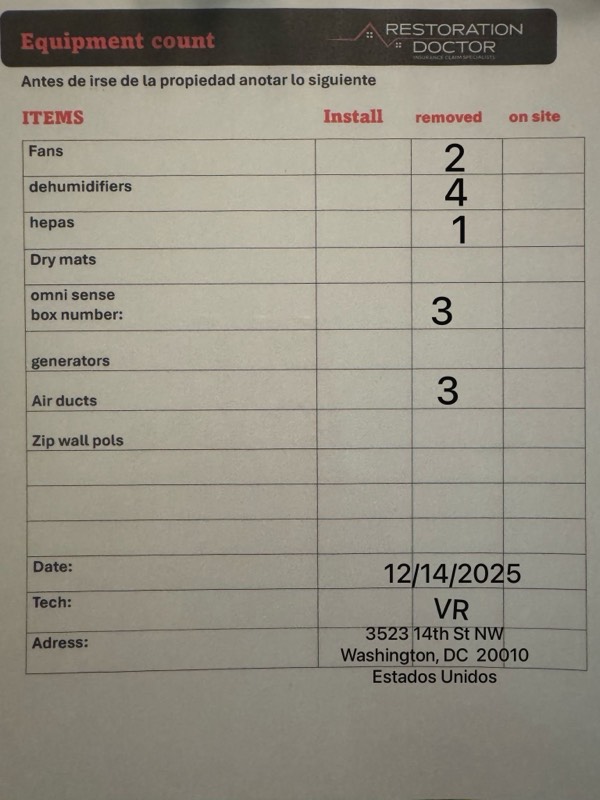
Residential water damage restoration — Montgomery County, MD
A documented Montgomery County residential water loss taken from extraction through monitored drying to verified dry standards, keeping salvageable finishes in place wherever possible.
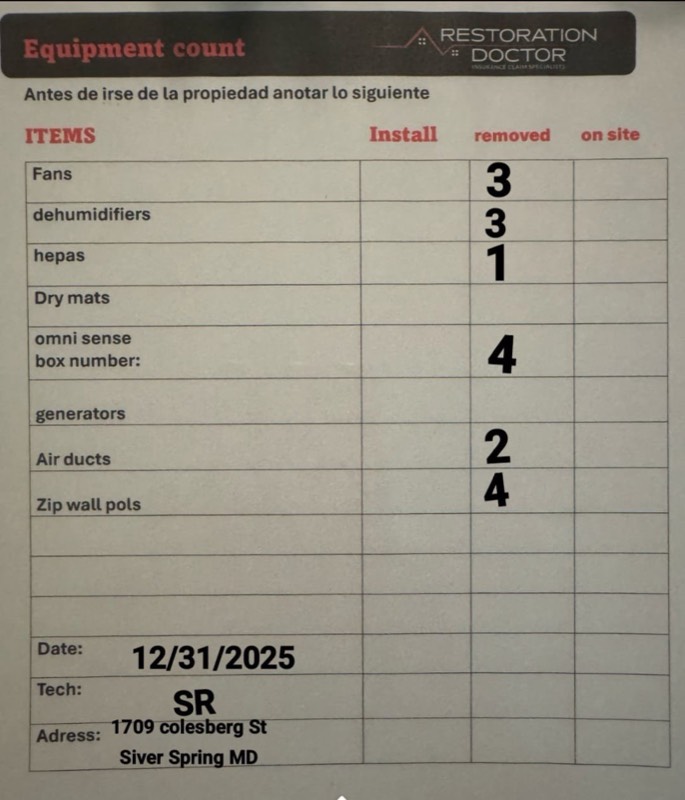
Moisture mapping & structural drying — Montgomery County, MD
A documented Montgomery County project where crews mapped the hidden moisture footprint with meters and thermal imaging, then set targeted structural drying to the wet assembly.
Full restoration services in Takoma Park
One operation covers every category — from emergency mitigation to full reconstruction.
Water Damage Restoration
Extraction, structural drying, and moisture verification for pipe breaks, appliance leaks, and English-basement flooding across the District.
Sewage & Biohazard Cleanup
Category 3 black-water decontamination with full PPE, contaminated-waste removal, antimicrobial treatment, and verified drying after sewer backups and overflows.
Mold Remediation
IICRC S520 containment, HEPA filtration, safe source-based removal, and independent post-remediation clearance verification.
Fire & Smoke Damage Restoration
Soot and smoke-residue removal, source-based odor neutralization, contents pack-out, and preservation-sensitive reconstruction after a fire — performed to ANSI/IICRC S700, the fire and smoke damage restoration standard.
Storm Damage Restoration
Emergency tarping, water extraction, and reconstruction after wind, heavy rain, and the flash flooding DC's summer storms produce.
Reconstruction & Repairs
Drywall, plaster, flooring, cabinetry, trim, and paint — the same in-house crew that dried the loss rebuilds it, with no handoff and preservation-sensitive finish matching for District homes.
Water Extraction & Structural Drying
Truck-mounted and portable extraction, air movers, dehumidifiers and dated moisture readings that decide when the equipment comes out.
Hardwood Floor Drying
In-place drying of wet hardwood floors with moisture and thermal mapping, air movers and dehumidifiers, and a clear line on which boards can be saved.
Emergency Roof Tarping
A temporary tarp over storm or impact damage to a roof, followed by drying of the water that already reached the interior.
Smoke & Soot Cleaning
Soot cleaned by surface type, odor treated at the source, HVAC cleaning and a real Washington, DC fire-damage file.
Contents Pack-Out & Restoration
Photographed, itemized pack-out, controlled cleaning and storage, and return of belongings when the home is ready.
What Takoma Park homeowners look for
Takoma Park is a tight-knit, engaged community where people compare notes on contractors, and many residents care about keeping an older house's character intact. That is a fair standard: clear communication, restraint about what gets torn out and written documentation at each step.
We do not print review counts or star ratings on this page. Our customer feedback lives on a separate reputation hub instead: visit RestorationDoctorsReviews.com to see the reviews and the real Google aggregate for yourself, then come back here to book service for your Takoma Park home. Keeping ratings on a source-linked hub rather than typing numbers onto a marketing page is a deliberate honesty choice.
Showing 4- and 5-star reviews. See all reviews on Google.
Frequently asked
Active water, mold, fire, or sewage event?
Connect directly with the Restoration Doctor team for your region. Crews are on standby 24/7 with documented response protocols.