
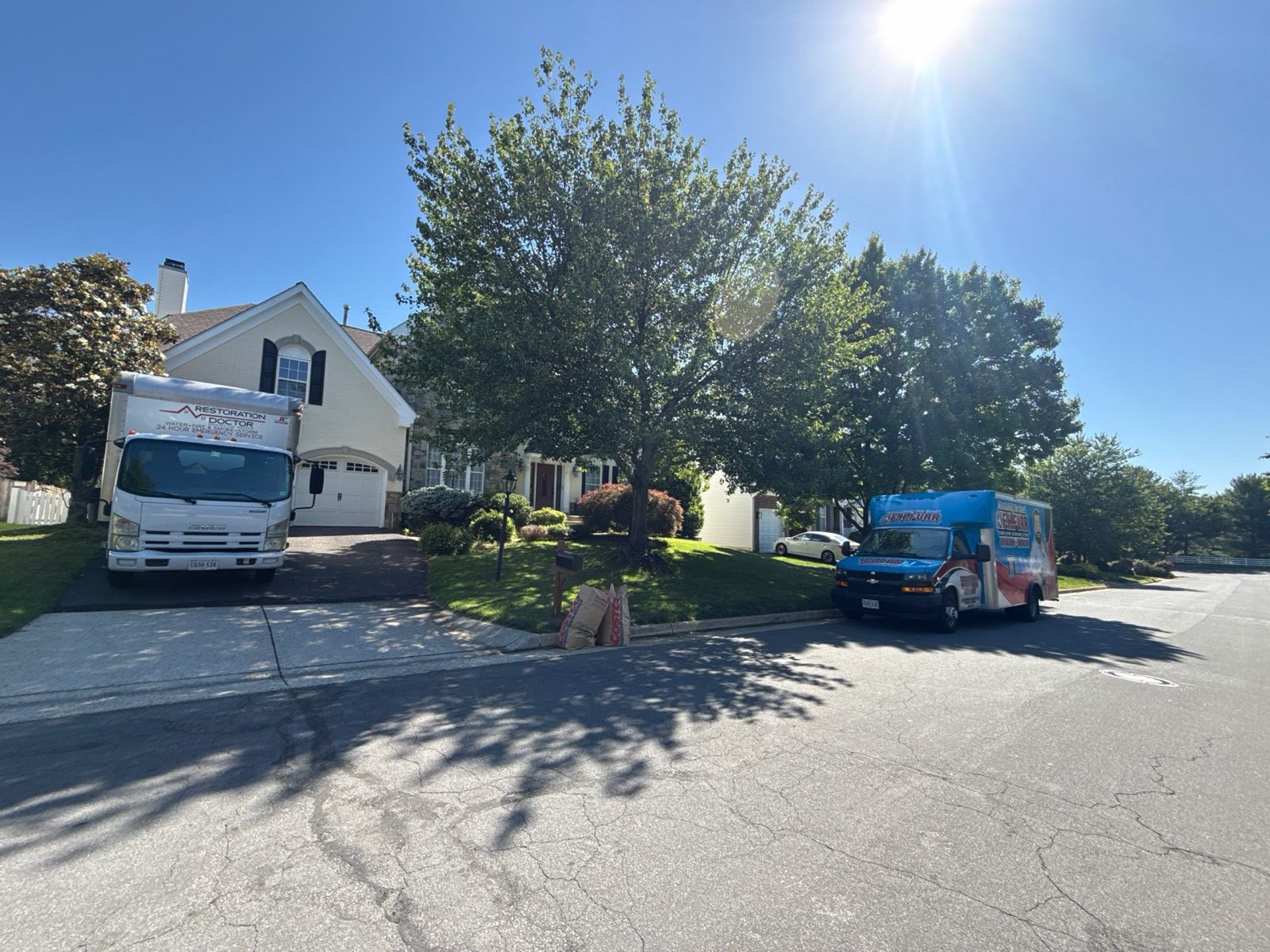
Restoration Company in Washington DC
Water, fire, storm, mold, and sewage restoration from a crew based inside the District — dispatched 24/7 and typically on-site within 60 minutes in Washington, DC. Licensed in DC, IICRC-standard methods, and a claim file built for your carrier to read when it reviews the loss.
Restoration Doctor of Washington DC is IICRC-certified, S500 / S520-aligned, licensed and insured. It works in Washington, DC under DC Basic Business License #410524000721, held by VA Water Damage LLC dba Restoration Doctor.
Restoration Doctor of Washington DC is a restoration company in Washington DC, based at 4315 50th St NW Suite 100 #7112, Washington, DC 20016, reachable around the clock at (202) 922-1444. Our crews are local to the District. The trucks that answer a burst riser in Logan Circle at two in the morning are staged inside the metro, not dispatched from an outer-suburb warehouse after somebody wakes up a subcontractor.
That is not a marketing distinction. Response time is the single largest lever on how much of a building has to come out. Water migrates through wall cavities and under flooring for every hour it sits, gypsum wicks it upward, and the line between drying a room in place and demolishing it is usually measured in hours rather than days. A company an hour outside the Beltway has already lost the part of the job that cannot be recovered later, no matter how good the crew is when it finally arrives.
If the loss is active as you read this, the page you want is emergency restoration dispatch in Washington, DC, which sets out the clock from your call to the first hour on site.
Who we are
Restoration Doctor of Washington DC is the District operation of Restoration Doctor, a restoration contractor headquartered in Vienna, Virginia. The DC office sits at the top of Wisconsin Ave where the District meets Friendship Heights, which puts crews inside the city for a Petworth call and a short run down Connecticut or over Rock Creek for most of the rest of it. We are a contractor, not a lead broker and not a call center that sells your emergency to whoever answers first.
The licensed entity behind every job is VA Water Damage LLC dba Restoration Doctor. In the District it holds DC Basic Business License #410524000721, issued by the DC Dept. of Licensing & Consumer Protection in the General Contractor / Construction Manager category. That number is public and you should check it, along with the license of anyone else bidding your work. Our Virginia and Maryland credentials are published on the same page as the DC one, because a metro-area loss regularly crosses a border: a Chevy Chase, DC homeowner and a Chevy Chase, MD homeowner live a few blocks apart and answer to two different regulators.
Field crews work to the consensus standards that govern this trade rather than to a house rulebook. ANSI/IICRC S500 sets how a water loss is categorized, dried, and documented. S520 governs mold containment, remediation, and post-remediation verification. S700 covers fire and smoke. In practice those standards are the difference between a drying plan built from daily moisture readings and psychrometric math, and one built from a technician's guess about how long to leave the fans running before somebody needs them on the next job.
Dispatch answers 24 hours a day, 365 days a year, because water damage does not schedule itself for business hours. The first four hours of a Category 3 sewage backup decide whether a finished basement gets decontaminated or gutted, and the first day of a fire loss decides how much of the smoke residue sets permanently into finishes. Mitigation, mold work, contents handling, and the reconstruction that puts the property back are all carried by the same operation under one file, so nobody gets handed off mid-claim and no trade points at the other when the drywall goes back up.
What we restore
Restoration is not one service. What people call water damage in the District covers at least five separate jobs: a supply line that let go on the third floor of a rowhouse, an English basement that took stormwater in through a silted areaway drain, a combined sewer that surcharged back up the lateral during a summer downpour, a slow leak behind a kitchen wall that grew mold before anyone smelled it, and a fire whose real damage is the suppression water plus the smoke that migrated into every closet on the floor. Each is scoped, dried, and documented differently. These are the categories we run, each with its own page and its own method.
Water damage restoration
Emergency extraction, thermal imaging, moisture mapping, and structural drying to IICRC S500 for burst supply lines, appliance failures, roof leaks, and below-grade flooding.
Fire and smoke damage restoration
Soot and smoke residue removal, source-based odor neutralization, and preservation-sensitive rebuild to IICRC S700, including the suppression water the fire department leaves behind.
Storm damage restoration
Emergency board-up and tarping, wind-driven rain intrusion, failed roofs, and cleanup after the squall lines that run up the Potomac every summer.
Mold remediation
IICRC S520 containment, negative air, HEPA filtration, and post-remediation verification for below-grade DC spaces where the humidity never really leaves.
Sewage and biohazard cleanup
Category 3 decontamination for combined sewer backups and failed laterals, with full PPE protocols, antimicrobial treatment, and verification before anything is rebuilt.
Contents cleaning and pack-out
Affected personal property inventoried, photographed, packed out, cleaned, and stored, then itemized so the personal-property side of the claim is documented rather than estimated. Handled as part of our fire and smoke work.
Reconstruction and repairs
Drywall, plaster, trim, flooring, paint, cabinetry, and the licensed trades to put the property back after mitigation, estimated in the same line-item file as the mitigation itself.
Every quadrant of the District, plus close-in Maryland and Northern Virginia
We cover all four quadrants of the District. Not the three neighborhoods with the best housing stock, and not a ring around downtown: all four quadrants, every night of the year. The building types change quadrant to quadrant, and so does the failure mode, which is why the scope for a Georgetown federal rowhouse and a Navy Yard high-rise unit look nothing alike even when the water came from the same kind of fitting.
Northwest Washington, DC
The oldest and densest housing stock in the city, plus every block that drains toward Rock Creek. Federal and Victorian rowhouses with plaster over lath, converted apartments, and 1920s co-ops where one failed riser runs down four floors before anybody finds the shutoff.
NEIGHBORHOODS: Georgetown, Dupont Circle, Adams Morgan, Logan Circle, Foggy Bottom, Kalorama, Mount Pleasant, Columbia Heights, Petworth, Cleveland Park, Woodley Park, Glover Park, Tenleytown, Friendship Heights, Palisades, Brightwood, Shepherd Park
Northeast Washington, DC
Brick rowhouses and bungalows alongside a wave of newer condo construction along the Red Line. Older clay laterals under the older blocks make sewer backups a recurring event rather than a one-off, especially after a heavy summer rain.
NEIGHBORHOODS: Brookland, NoMa, Eckington, Trinidad, Ivy City, Langdon, Woodridge, Michigan Park, Riggs Park, Fort Lincoln, Kingman Park, Deanwood
Southeast Washington, DC
Historic Capitol Hill rowhouses with shared party walls and cellar-level kitchens, plus the Navy Yard and Green Line corridor where a single unit loss becomes a stack loss through three floors of finished units.
NEIGHBORHOODS: Capitol Hill, Navy Yard, Barney Circle, Hill East, Anacostia, Fairlawn, Hillcrest, Penn Branch, Randle Highlands, Congress Heights
Southwest Washington, DC
Mid-century co-ops and towers next to new waterfront construction, sitting low and close to the Washington Channel, where below-grade parking and storage levels take water first and the building's own pumps decide how bad it gets.
NEIGHBORHOODS: Southwest Waterfront, The Wharf, Buzzard Point, Fort McNair area, L'Enfant Plaza
Each page carries its own housing stock, drainage, and water-risk detail for that area.
Beyond the District, the same crews cover Montgomery County, Maryland, including Bethesda, Chevy Chase, Silver Spring, Takoma Park, and Kensington, and Prince George's County, Maryland, including Suitland, Oxon Hill, Fort Washington, National Harbor, Clinton, and Camp Springs. On the Virginia side we cover close-in Northern Virginia: Arlington, Alexandria, Falls Church, McLean, Vienna, Tysons, Annandale, and Fairfax. Anything inside or just outside the Beltway is a normal dispatch, not a special trip, and the Virginia work runs out of the same operation this office belongs to.
How to choose a restoration company in Washington DC
Almost everyone who calls us has already had at least one truck at the curb, often one that showed up unrequested. Restoration is one of the few trades where the buying decision gets made in a panic, at the worst possible hour, by someone standing in an inch of water with a phone in one hand. Here is what to verify before you sign anything, whether or not the company you are checking is this one.
- 1
Confirm the DC Basic Business License
Every contractor working in the District needs a Basic Business License from the DC Department of Licensing and Consumer Protection, with the correct category for construction work. Ask for the number, then verify it yourself through DLCP rather than trusting the number painted on a truck door. A company licensed only in Maryland or Virginia is not licensed to do your DC job, and plenty of trucks cross the line hoping nobody asks.
- 2
Ask which IICRC standard the work follows
S500 for water, S520 for mold, S700 for fire and smoke. A technician who cannot name the standard governing the job in front of them is not going to document to it. Ask who on the crew actually holds the certification rather than whether the letters appear in the company logo.
- 3
Verify insurance and ask for the certificate
General liability and workers compensation, current, with your property on the certificate. If a worker is injured in your basement and the company carries no comp coverage, that exposure has a way of landing on your homeowners policy instead of theirs.
- 4
Require daily moisture documentation in writing
Drying is a measured process, not a waiting period. You should receive daily readings for every monitored material, ambient temperature and relative humidity for each drying chamber, and a record of what equipment ran where and for how long. A company that cannot produce a moisture log cannot prove the structure reached a dry standard, and an adjuster is entitled to ask for exactly that record.
- 5
Get a written scope before demolition starts
You are entitled to know what is coming out and why before a saw is switched on. Emergency stabilization can and should start immediately, but demolition scope belongs on paper. A verbal promise to see what we find is how a two-room loss turns into a whole-floor tear-out that nobody authorized.
- 6
Ask how historic district and permit rules will be handled
Georgetown, Capitol Hill, and dozens of other DC historic districts carry design review through the Historic Preservation Office, and exterior work, windows, and roofing can require review before it begins. A restoration company in Washington DC that has never pulled a DC permit will discover this halfway through your rebuild, and you will pay for the discovery in schedule.
- 7
Ask about party walls and the attached house next door
In a rowhouse the wall you share is a shared building assembly. Water tracks through masonry, joists commonly bear into the party wall, and drying one side while the other stays wet simply relocates the mold problem. Any competent scope on an attached house addresses the neighboring structure, and any competent contractor tells you plainly when they need access to it.
- 8
Do not sign under pressure at the door
Nobody needs your signature in the first ten minutes. Door-knocking and storm-chasing crews run on urgency because urgency is what stops people reading. Read the authorization, look hard at any open-ended assignment of benefits language, and understand what you are agreeing to pay before you sign. A company unwilling to give you fifteen minutes to read the paperwork has told you something useful about itself.
We work for you, not the insurance company
Our billing model is different from most of this industry, so it is worth stating plainly. We bill the property owner. You are the customer, you hold the contract, and you hold the claim file. We then build you a complete, carrier-ready package for your insurer to read when it reviews the loss: a line-item estimate written in Xactimate, the format adjusters and third-party administrators actually read, time-stamped photographs of every phase, daily moisture and psychrometric logs, an equipment record, and a written scope narrative explaining why each activity was necessary.
The reason is structural, not administrative. A restoration contractor whose revenue arrives from the carrier answers to the carrier. When an adjuster wants a line struck, a drying day cut, or a room reclassified, the company that depends on that adjuster's approval has an obvious incentive to agree. We work for you, not the insurance company. If the correct scope is four drying days and the carrier wants to pay for two, our documentation still says four, and you are the one holding the evidence.
What this does not mean: we do not adjust your claim, we do not negotiate on your behalf, and we are not public adjusters. What we do is make the technical record complete enough that there is very little left to argue about. Photos keyed to rooms, readings keyed to dates, line items keyed to the same estimating platform the carrier prices from. Most disputes over a mitigation invoice are really disputes about evidence, and a clean file is the answer to that.
The file stays yours whatever happens next. If you change carriers, bring in an attorney, sell the property, or need to show three years from now at closing that a loss was remediated properly, the documentation belongs to you and not to us. It also keeps deductibles honest: your deductible is yours to pay, and we do not pad a scope to absorb it for you.
You hold the contract and you hold the claim file. We bill the property owner and give you the Xactimate estimate, the photographs, and the moisture logs your carrier reads when it reviews the loss.
The paperwork standard is the same one the company has used since Vienna: read how Restoration Doctor documents an insurance claim for the full walk-through of what ends up in your file.
What happens in the first 24 hours
Restoration is won or lost on day one. This is the sequence on a typical District water loss, and roughly the clock it runs on.
- 01The call is answered live
(202) 922-1444 reaches a person 24 hours a day. On that call we take the address, the source if you know it, whether the water is clean, gray, or sewage, whether power is safe, and where the shutoff is. If the source is still running we walk you through stopping it before the truck arrives, because that call is free and the water is not.
- 02A crew is dispatched from inside the metro
Trucks stage in the District and the close-in suburbs, so a call from Capitol Hill, Petworth, or the Southwest Waterfront gets an inside-the-Beltway response. Overnight and weekend calls run the same way weekday calls do, with the same equipment and the same documentation.
- 03Source control and safety, first hour on site
Stop or isolate the water, de-energize affected circuits where needed, and clear immediate hazards. On a sewage loss the affected area is contained before anything else happens, because a Category 3 event is a health problem before it is a building problem.
- 04Scope and moisture map
Thermal imaging plus penetrating and non-penetrating meters, room by room, to find where the water actually went. Water runs down and sideways through wall cavities and under flooring, so the wet area is nearly always larger than the visible stain. Every reading and every affected room is photographed and logged from this point on.
- 05Extraction and stabilization
Standing water removed, saturated carpet and pad handled, non-salvageable material identified and separated. Contents at risk are moved, blocked up off wet floors, or packed out and inventoried before they take on more damage.
- 06Drying equipment set to a calculated plan
Air mover and dehumidifier counts are calculated from the affected area, the class of loss, and the psychrometric conditions in the space, not from whatever happens to be left on the truck. Containment goes up where it will speed drying or protect unaffected rooms.
- 07Daily monitoring until the dry standard is met
A technician returns each day, records readings for every monitored material, adjusts equipment placement, and logs it. Equipment comes out when materials reach the dry standard verified by meter, not when the calendar hits three days.
- 08The file, and what comes next
You receive the documentation package and the Xactimate estimate. If reconstruction is needed, the rebuild is scoped and estimated inside the same file, so nothing falls into the gap that opens when mitigation and repairs are split between two companies.
A reputation you can check yourself
We publish our review record on a separate, source-linked hub instead of typing a rating onto this page. The number shown there is the live Google aggregate for the Washington DC listing, critical reviews included, and it reconciles against the Google Business Profile itself.
That is deliberate. Any company can print stars on a marketing page. The useful question about a restoration company in Washington DC is whether its reputation is checkable, so read the whole record and judge the pattern across water, fire, mold, and sewage jobs rather than the three testimonials somebody selected.
Rather than print a rating here that you would have to take on faith, we keep the live aggregate and the full review list on a source-linked hub where you can reconcile it against the Google listing yourself.
View the live aggregateFrequently asked
Talk to a restoration company based in the District
Call (202) 922-1444 for 24/7 dispatch, or send the form and we will call you back. If water is still running, call rather than type.
- Crews staged inside the metro, dispatched 24/7
- IICRC S500 / S520 / S700 methods with daily moisture logs
- Line-item Xactimate estimate and a carrier-ready claim file you keep
Active water, mold, fire, or sewage event?
Connect directly with the Restoration Doctor team for your region. Crews are on standby 24/7 with documented response protocols.