
Water Damage Restoration in Suitland, MD
Water damage restoration in Suitland, MD is, more often than not, a basement story. The neighborhoods that grew up around the Suitland Federal Center were built fast and built for federal workers — compact brick ramblers, Cape Cods, and split-levels from the 1940s through the 1960s, most sitting on full basements that families long ago turned into bedrooms, laundry rooms, and storage. When water shows up in a Suitland home, that below-grade space is where it lands, and Restoration Doctor answers those calls around the clock because a basement soaks in a way an upstairs floor never does.
The other half of the Suitland story is the pipes underground. This part of Prince George's County runs on the WSSC system, and many of the sewer laterals connecting these older houses to the main have been in the ground for sixty or seventy years. Roots, grease, and simple age crack and clog those lines, and when a lateral backs up, the water that comes up through a basement floor drain is not clean — it is a Category 3 sewage event that has to be handled as a biohazard, not mopped up like a spill.
Whether you own a rambler off Silver Hill Road, a Cape Cod near Suitland Parkway, or a split-level backing onto the federal campus, the job runs the same way: find and stop the source, pull the water out fast, dry the structure to a verified moisture standard, and write down every reading so your insurance claim is built on documentation instead of guesswork. Below is how water actually moves through Suitland homes, and what we do about each way it gets in.
How water damage behaves in Suitland
When the sewer lateral backs up
The signature Suitland emergency is a sewage backup. An aging WSSC lateral clogs with roots or grease, or the county main surcharges during heavy rain, and wastewater pushes back up through the lowest fixture in the house — usually a basement floor drain, laundry standpipe, or toilet. What surfaces is Category 3 water: contaminated, hazardous, and impossible to sanitize back into safe living space by drying alone.
We handle these as biohazard events. Crews extract the contaminated water, remove and bag porous materials that cannot be disinfected — carpet, pad, saturated drywall, and affected contents — then clean and apply antimicrobial treatment to every surface that stays. Only after the space is decontaminated do we set structural drying and monitor to a verified dry standard. Our in-house plumbing team can clear or repair the failed lateral so the same backup does not return the week after we leave.
Finished basements and the appliances above them
Even without a sewer problem, the Suitland basement is the low point where water collects. A water heater that lets go, a burst washing-machine hose, or a supply line that fails on the main floor sends water straight down to the basement, where it saturates carpet pad, wicks up into drywall, and soaks the bottom plates of framed walls before anyone notices. Finished below-grade space dries slowly on its own, so we lean on monitored in-place drying with low-grain refrigerant and, where the load calls for it, desiccant dehumidification.
We map the wet footprint with moisture meters and thermal imaging rather than guessing from the visible stain, then dry cavities in place wherever the readings let us and open only what genuinely has to come out. In a modest home where the basement bedroom or rec room is real living space, drying and preserving instead of gutting is exactly what keeps a manageable loss from turning into a full renovation.
Storm runoff and groundwater seepage
Suitland's older foundations were not built for the volume of runoff that a modern Prince George's County thunderstorm can dump in an hour. When the ground saturates, hydrostatic pressure builds against below-grade walls and water finds its way in through cracks, cove joints, and around the slab — often overwhelming a sump pump that is undersized, worn out, or running on a dead backup battery.
Groundwater that has traveled through soil is not clean Category 1 water, so we treat storm seepage as the Category 2 event it is: extraction, selective removal of unsalvageable porous materials, antimicrobial treatment, and drying to a verified standard. Undried moisture behind a finished basement wall is the single most common way hidden mold starts in these homes, so when we find existing growth we remediate it under IICRC S520 with containment, and on a fresh loss we dry the assembly out before mold ever gets a foothold.
Suitland housing stock and how it fails
Suitland's housing was shaped by the federal government's arrival. As the Suitland Federal Center and the Census Bureau drew thousands of workers, developers filled the surrounding blocks with modest, durable single-family houses — brick and frame ramblers, story-and-a-half Cape Cods, and later split-levels — on small lots close together. These are working homes: solid masonry, simple floor plans, and almost universally a full basement underneath. Over the decades those basements became the extra square footage a growing family needed, finished with paneling, drywall, drop ceilings, and carpet that hold water and grow mold quickly once wet.
Because so much of Suitland dates to the same two or three decades, the homes tend to share the same vulnerabilities: original or first-replacement supply lines, cast-iron and clay drain runs, and foundations that predate modern waterproofing. That uniformity is useful to us — when we walk into a Suitland basement, we already know where to look for the water and how the assembly is likely built. It also means a single failure mode, like an aging sewer lateral or a tired water heater, tends to repeat across a whole street, which is why we treat every Suitland loss as both a structural drying job and a chance to flag the risk that caused it.
Areas of Suitland we serve
Real Suitland blocks and buildings — and the water losses we most often see in each.
Post-war ramblers and Cape Cods on aging WSSC laterals where basement sewage backups are the common emergency.
Compact 1940s-60s homes built for federal workers, nearly all with full finished basements that collect water at the low point.
Brick ramblers and split-levels with original-era supply lines prone to water-heater and pinhole failures.
Older single-family homes near Suitland where storm runoff and hydrostatic pressure drive basement seepage.
Split-levels on small lots where an upstairs appliance failure travels straight down to finished lower levels.
Mid-century houses with aging drain runs where clogged laterals surcharge into basement floor drains.
Documented project files
Real CompanyCam-documented Restoration Doctor work in the Washington, DC metro — every project photographed with date and time stamps.
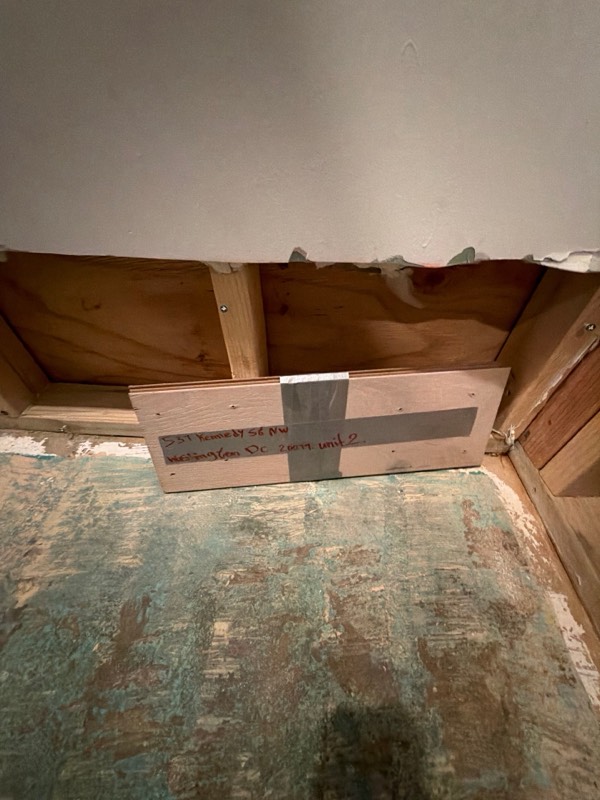
Basement water damage dry-out — documented Washington, DC project
A documented Washington, DC basement loss carried from extraction through monitored structural drying, with low-grain dehumidifiers and air movers set to the wet footprint and verified to a dry standard — the same below-grade approach we bring to Suitland ramblers.
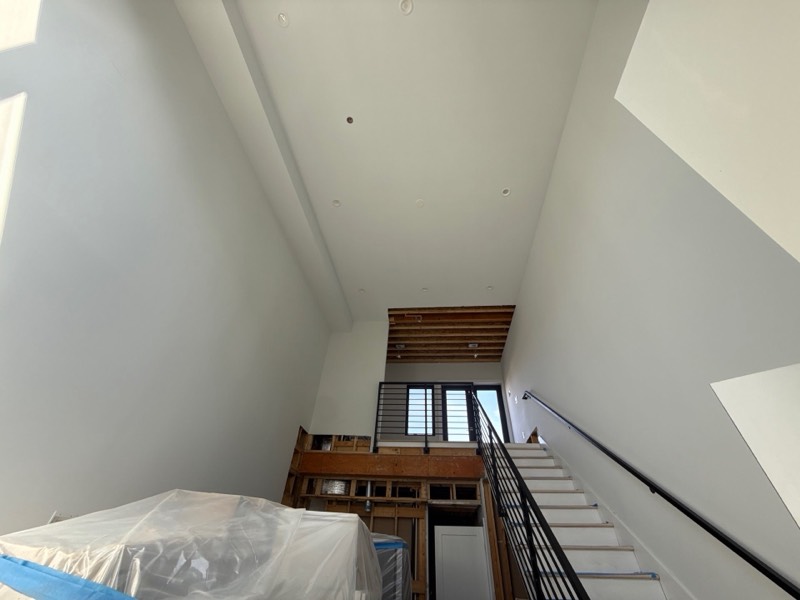
Hardwood floor water damage drying — documented Washington, DC project
A documented Washington, DC project where crews dried water-damaged hardwood in place with directed airflow and dehumidification, preserving the floor rather than tearing it out — the restraint we apply to finished Suitland basements.
Full restoration services in Suitland
One operation covers every category — from emergency mitigation to full reconstruction.
Water Damage Restoration
Extraction, structural drying, and moisture verification for pipe breaks, appliance leaks, and English-basement flooding across the District.
Sewage & Biohazard Cleanup
Category 3 black-water decontamination with full PPE, contaminated-waste removal, antimicrobial treatment, and verified drying after sewer backups and overflows.
Mold Remediation
IICRC S520 containment, HEPA filtration, safe source-based removal, and independent post-remediation clearance verification.
Fire & Smoke Damage Restoration
Soot and smoke-residue removal, source-based odor neutralization, contents pack-out, and preservation-sensitive reconstruction after a fire — performed to ANSI/IICRC S700, the fire and smoke damage restoration standard.
Storm Damage Restoration
Emergency tarping, water extraction, and reconstruction after wind, heavy rain, and the flash flooding DC's summer storms produce.
Reconstruction & Repairs
Drywall, plaster, flooring, cabinetry, trim, and paint — the same in-house crew that dried the loss rebuilds it, with no handoff and preservation-sensitive finish matching for District homes.
What Suitland homeowners look for
In a neighborhood of practical, hard-working homeowners, the thing worth vetting in a restoration company is straightforward: do they show up fast, do they know how to handle a sewage backup safely, and do they document the loss honestly enough that a claim holds together. Suitland families are not looking to be sold — they want the water gone, the basement safe, and a paper trail that protects them with their carrier.
You will not find review counts or star ratings printed on this page. Our verified customer feedback lives on a separate reputation hub instead: visit RestorationDoctorsReviews.com to read the reviews and see the genuine Google aggregate for yourself, then come back here to schedule service for your Suitland home. We keep the numbers on a source-linked hub rather than typing them onto a marketing page on purpose — the figures there are the real Google totals, not something we invented.
Frequently asked
Active water, mold, fire, or sewage event?
Connect directly with the Restoration Doctor team for your region. Crews are on standby 24/7 with documented response protocols.