
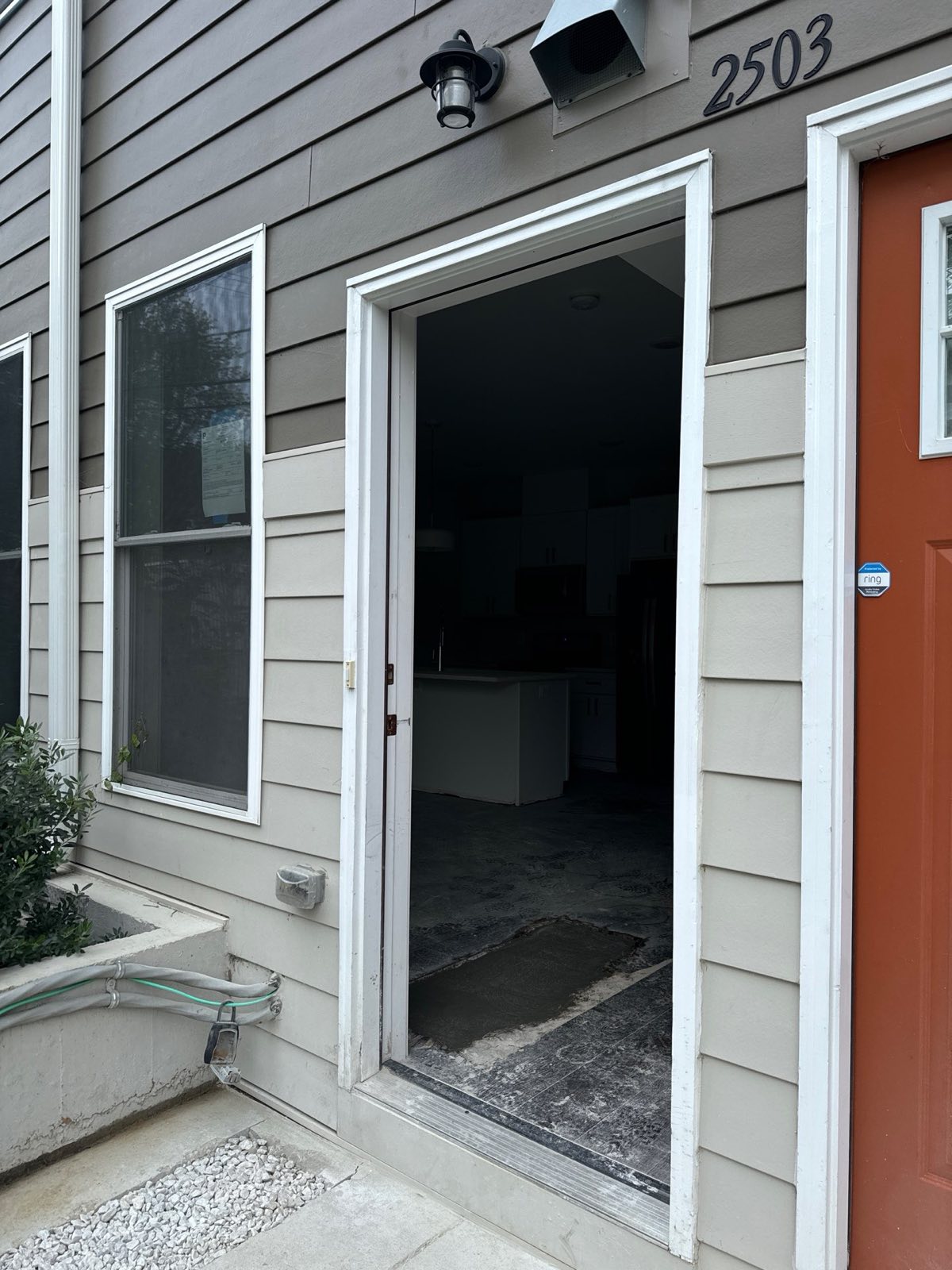
Water Damage Restoration in Washington, DC
Emergency extraction, structural drying, and documented moisture verification for burst pipes, appliance failures, and below-grade flooding in DC rowhouses, condos, and single-family homes.
Why a DC water loss spreads faster than it looks
A water emergency in Washington, DC is rarely contained to the room where it starts, and the reason is the way the city is built. So much of the District is attached housing — Capitol Hill and Shaw rowhouses, Georgetown federals, Columbia Heights apartment buildings, condo and co-op buildings with units stacked three and four high. Water does not respect a property line or a lease. When a supply line lets go on an upper floor of a rowhouse, it travels along the shared party wall and the floor framing into the home next door; when a water heater fails in a condo, the loss is often discovered two units below. What begins as one homeowner's burst pipe becomes a multi-unit, multi-owner event within hours.
The chemistry of the loss is working against you the whole time. Under the IICRC S500 standard, clean Category 1 water begins degrading toward Category 2 in roughly 48 hours and toward Category 3 within about 72, and every category jump enlarges the scope, lengthens the drying timeline, and raises the cost. The water you can see on the floor is a fraction of the water already wicking into drywall, sill plates, subfloor, and — in older DC homes — the lath and plaster and original millwork that make those houses worth restoring in the first place.
That is why response speed matters more than any single machine. Restoration Doctor of Washington DC runs around-the-clock dispatch. The objective on the first visit never changes: stop the source, remove standing water before it soaks deeper, and get the structure into a controlled drying environment while the loss is still small and still clean.
Extraction and structural drying, room by room
Every project opens with an IICRC S500 inspection. We classify the water category and the saturation class, then map moisture room by room with pinless meters and thermal imaging so the drying plan is built on readings, not guesses. Thermal cameras find the cold, wet patches behind a plaster wall or under a hardwood floor that look perfectly normal to the eye — which is exactly where drying equipment needs to go instead of blanketing a room and hoping.
Extraction comes next. A small supply-line break is handled with portable units; a flooded English basement or a multi-room condo loss calls for truck-mounted extractors that pull water at a far higher rate and get the structure out of standing water fast. Once the bulk water is gone, we build the drying system — air movers to sweep moisture off surfaces, and low-grain refrigerant (LGR) or desiccant dehumidifiers to pull that moisture out of the air and exhaust it. Where original hardwood, plaster, or dense masonry is involved, we add specialty systems like floor-drying mats and injection drying rather than tearing out material that can be saved.
Then we monitor. Drying is not a set-it-and-forget-it process. We log a pre-drying baseline, take daily moisture readings, and reposition equipment as the numbers fall. Materials are considered dry when they hit documented targets — not when a week has passed on the calendar. We demolish only what genuinely cannot be dried in place, because controlled in-place drying preserves finishes, protects the historic character of older DC homes, and shortens the reconstruction phase.
Below-grade flooding and the District's basement problem
Below-grade space is the defining water risk in Washington. English basements and basement apartments are everywhere in the District, and they sit at the exact elevation where water collects — against foundation walls, at floor drains, and at the base of exterior stairwells that funnel runoff straight to a doorway. Many of these spaces are finished and occupied, so a few inches of water is not a nuisance in an unused cellar; it is a soaked living room, a tenant's flooded apartment, and a Category question that has to be answered on arrival.
Chronic below-grade moisture also compounds. A basement that takes on water repeatedly holds humidity in the slab and the lower courses of the walls long after the visible water is gone, and that trapped moisture is what grows mold and rots framing weeks later. We treat a basement loss as a drying problem for the whole assembly — slab, walls, and the air — not just a pump-out, and we document the moisture down to the substrate so the space is verified dry before anyone rebuilds over it.
Documentation your carrier can approve on the first read
A water loss is also a paperwork event, and a company that dries your home beautifully but documents it poorly can still leave you fighting your insurer. Our crews photograph every phase with date and time stamps, keep daily moisture logs, and write estimates in Xactimate — the platform adjusters use — with line-item notes explaining what was done and why. A scope that arrives as a proper Xactimate workfile with photo support, a moisture log, and equipment specifications is one an adjuster can move on quickly instead of kicking back for revisions.
Our role is to document the loss thoroughly and hand you a complete, carrier-ready file. We are not public adjusters and we do not negotiate your claim for you or represent you before your insurer — we produce the evidence that supports it. And the choice of contractor is always yours: under your policy you have the right to select any licensed, qualified restoration company, and an insurer cannot require you to use its preferred vendor. You sign our work authorization, so the invoice is yours; that documentation is what your carrier reads when it decides what to reimburse you.
Loss happening right now? how our emergency crews work the first hour.
How our water damage response works
From the first call to the final moisture reading, a water loss follows a fixed sequence. Here is exactly what happens when you call us for a water emergency in the District.
- Dispatch & source control
We answer around the clock and get a crew moving immediately. The first job on site is to stop the water — shutting the failed supply line, fixture, or building valve — and to make the area safe, including cutting power to wet zones where outlets or electronics are involved. In a rowhouse or condo, we also identify whether the source or the damage crosses into an attached unit so the right parties are looped in early.
- Inspect & classify
We perform an IICRC S500 inspection, classifying the water category and saturation class and mapping moisture room by room with pinless meters and thermal imaging. This is where we find the hidden water behind plaster walls, under hardwood, and inside floor cavities, and where the category and class get documented in writing — the labels your carrier's adjuster checks against.
- Extract standing water
We remove standing water fast, using portable units for a contained break and truck-mounted extractors for a flooded basement or a multi-room loss. Getting the structure out of standing water quickly is what keeps a clean Category 1 loss from degrading toward a contaminated, tear-out-heavy one.
- Build the drying system
We set air movers to sweep moisture off surfaces and LGR or desiccant dehumidifiers to pull it out of the air, adding specialty drying — floor mats, injection systems — where original hardwood, plaster, or masonry can be saved rather than demolished. The system is engineered to the readings, not spread blindly around the room.
- Monitor to dry standard
We log a baseline and take daily moisture readings, repositioning equipment as the numbers fall. The project is dry when materials hit documented targets — not on a fixed schedule. Every reading is recorded, which is both good drying practice and the backbone of the claim file.
- Document & hand off to rebuild
We compile the photos, moisture logs, and Xactimate scope into a carrier-ready file and, because reconstruction is in-house, move straight into putting the home back together — replacing flood-cut drywall, resetting trim, refinishing floors, and repainting under one accountable operation.
Frequently asked
Active water, mold, fire, or sewage event?
Connect directly with the Restoration Doctor team for your region. Crews are on standby 24/7 with documented response protocols.