Do You Need a DC Permit to Repair Water Damage? A Decision Tree
BY RESTORATION DOCTOR OF WASHINGTON DC · WASHINGTON DC & SOUTHERN MARYLAND
Emergency drying and cleanup do not require a building permit in the District, but the rebuild often does once structure, electrical or plumbing is involved. The contractor doing the work should pull the permit under their own license, and a contractor who offers to skip it is telling you what the rest of the job will look like.
Call (202) 922-1444Does emergency water mitigation need a permit at all?
No. The DC permit question for water damage repair does not attach to drying. Extraction, air movers, dehumidifiers, containment work and the removal of soaked carpet or wet insulation are cleanup rather than construction, and the District's building permit system is aimed at construction.
That covers the first days of almost every loss. Nobody waits on a permit to stop water spreading through a row house, and no inspector expects them to.
The confusion starts because mitigation and rebuild get quoted as one job. A crew arrives at midnight, cuts drywall to get behind wet baseboard, and the same company later offers to put the room back. The first half needed no permit. The second half might.
So the honest answer is this: emergency work proceeds now, and the permit question gets settled before the rebuild scope is signed. If someone tells you the whole job is exempt because it started as an emergency, that is not how the District reads it.
Which repairs are exempt from a DC building permit?
The District's construction codes, enforced by the Department of Buildings, contain a section listing work that is exempt from a permit. It is a specific list rather than a general rule, and the list itself is conditioned: the exemptions are subject to historic and flood hazard area restrictions, which is not a footnote in a city with this much historic-district row house stock.
On a water loss, the exempt side is mostly surface work. Paint, sealant and coatings. Papering, tiling, carpet and floor covering. Cabinets and countertops, so a vanity top set back onto the existing supply and waste. Caulking and patching, and plaster repair of assemblies that are not fire-rated. Read the section itself, or ask the agency, before assuming your address is clear of the historic and flood-hazard conditions attached to it.
The line moves the moment the work touches structure, a wall that carries load, anything feeding electricity or gas, or anything altering the plumbing. It also moves when the repair changes the layout or converts a space into habitable space it was not before.
DOB runs a wizard that walks an applicant through questions and identifies which permit type a scope needs. Use it, or ask the agency, rather than relying on what a crew tells you on a Saturday.
How do you work through the permit question step by step?
Run each line of your rebuild scope through the same five questions, in order, and stop at the first yes. It puts most water-loss scopes in the right lane before anyone fills in an application.
The tree below is a guide, not a ruling. DOB decides what your job needs, and the agency is reachable before you apply.
- 1. Am I only cleaning, drying or replacing a surface finish with the same thing? If yes, you are usually in maintenance territory and no building permit is in play.
- 2. Am I touching structure, framing, a load path, a stair or an exterior wall opening? If yes, expect a permit.
- 3. Am I extending, relocating or replacing wiring, a panel, a device or a circuit? If yes, expect an electrical permit under a licensed electrician.
- 4. Am I moving, replacing or re-piping any supply, waste, vent, gas line or water heater? If yes, expect a plumbing or mechanical permit under a licensed trade.
- 5. Am I changing the use or layout, finishing a basement, adding a bedroom or creating a separate dwelling unit? If yes, expect full permit review, and below grade expect more than one agency to care.
- A yes anywhere in steps two through five puts the permit in the schedule before demolition finishes, not after the drywall is hung.
| Work after the loss | What decides it | Where it usually lands |
|---|---|---|
| Extraction, air movers, dehumidification, containment | Cleanup, not construction | No building permit |
| Pulling out wet carpet, pad, baseboard, insulation | Removal of finishes, nothing structural | No building permit |
| Flood cut and drywall replaced like for like, no wiring moved | Replacement in kind, but capped at 160 sq ft and not fire-rated board | Exempt under the cap, permit question above it |
| Drywall or plaster removed from a load-bearing or party wall | Structure exposed or altered | Permit question, ask DOB |
| A soaked outlet, switch, junction box or panel replaced or relocated | Regulated trade work | Electrical permit, licensed electrician |
| Water heater, supply line, waste line or vent replaced or moved | Regulated trade work | Plumbing or mechanical permit, licensed trade |
| Basement rebuilt with new partitions, ceiling height changes or egress work | Layout and habitability change | Full permit review |
| A below-grade apartment reconfigured or added | Use and occupancy change | Permit review plus zoning and certificate of occupancy questions |
When does replacing drywall or plaster cross into permitted work?
This comes up on nearly every job, because drywall is the material that gets cut. A flood cut opens the bottom of the wall so the cavity can dry, and then it has to be closed again.
Closing that cut with the same board, in the same plane, with no wiring moved and no framing replaced, can fall inside the District's permit exemption for replacement in kind. That exemption has a ceiling. The code exempts not more than 160 square feet of gypsum board, and it excludes fire-rated wall board and shaft liner entirely. A flood cut run around the perimeter of one basement room passes 160 square feet quickly, so measure the board before assuming the work is exempt.
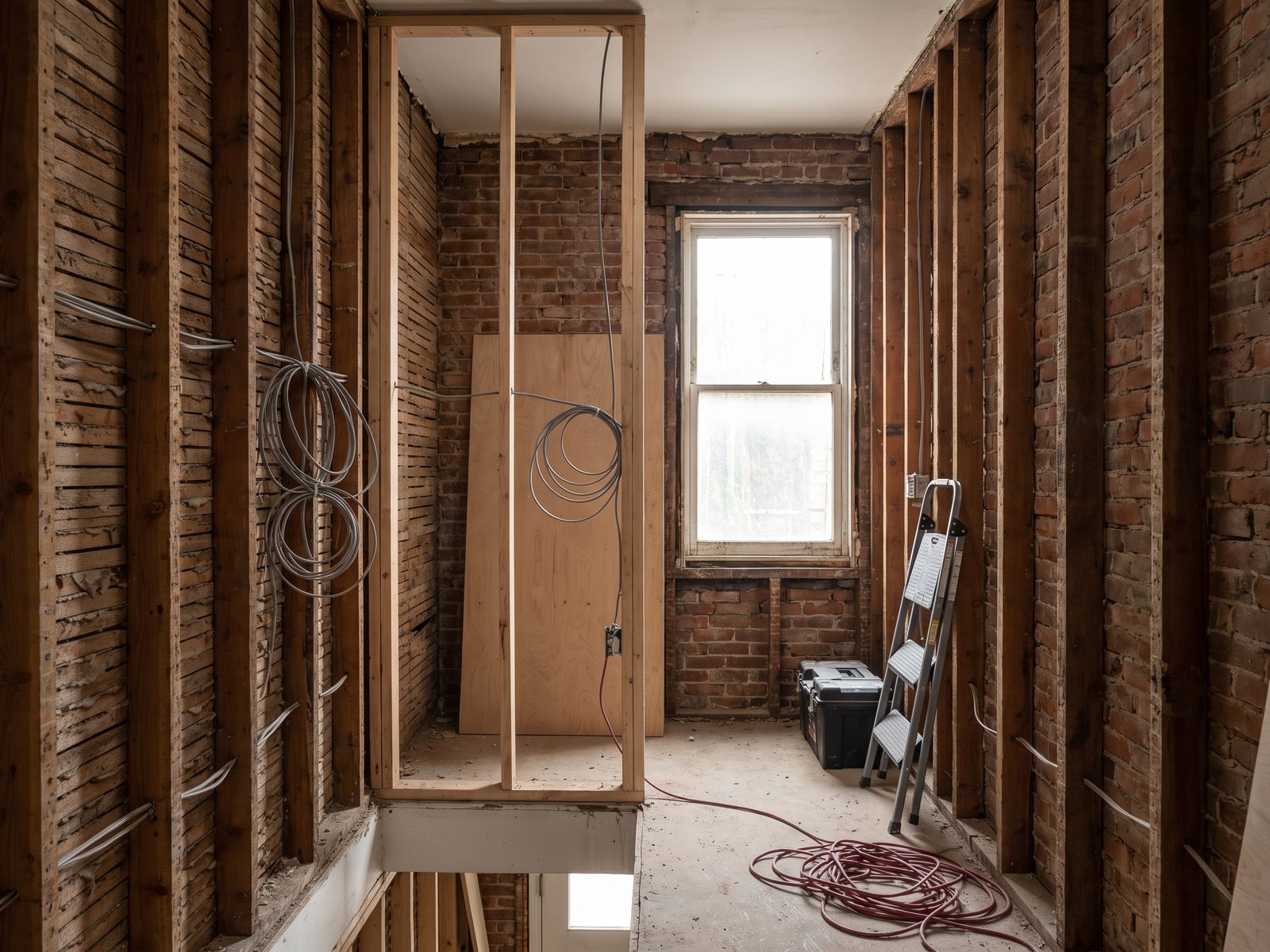
It stops being simple in three situations we see constantly in row houses. Wet framing has to be sistered or replaced, which is structural. Old plaster on wood lath sits against a masonry party wall and the repair reaches the assembly itself. Or the open cavity reveals wiring that must be corrected first, and now an electrical permit sets the schedule.
One decision comes before the permit question entirely: whether the board has to go at all. We wrote the repair-or-replace test for a wet wall on our sister site restorationdoctors.com, at https://restorationdoctors.com/blog/water-damaged-drywall-repair-or-replace. Settle that first. A wall that dries in place never raises a permit question.
What about electrical and plumbing that the water touched?
These are the trades where the District is least flexible, and rightly so. Electrical and plumbing work is permitted and inspected because the failure modes are fire and contaminated water, and neither shows up in a walkthrough at the end.
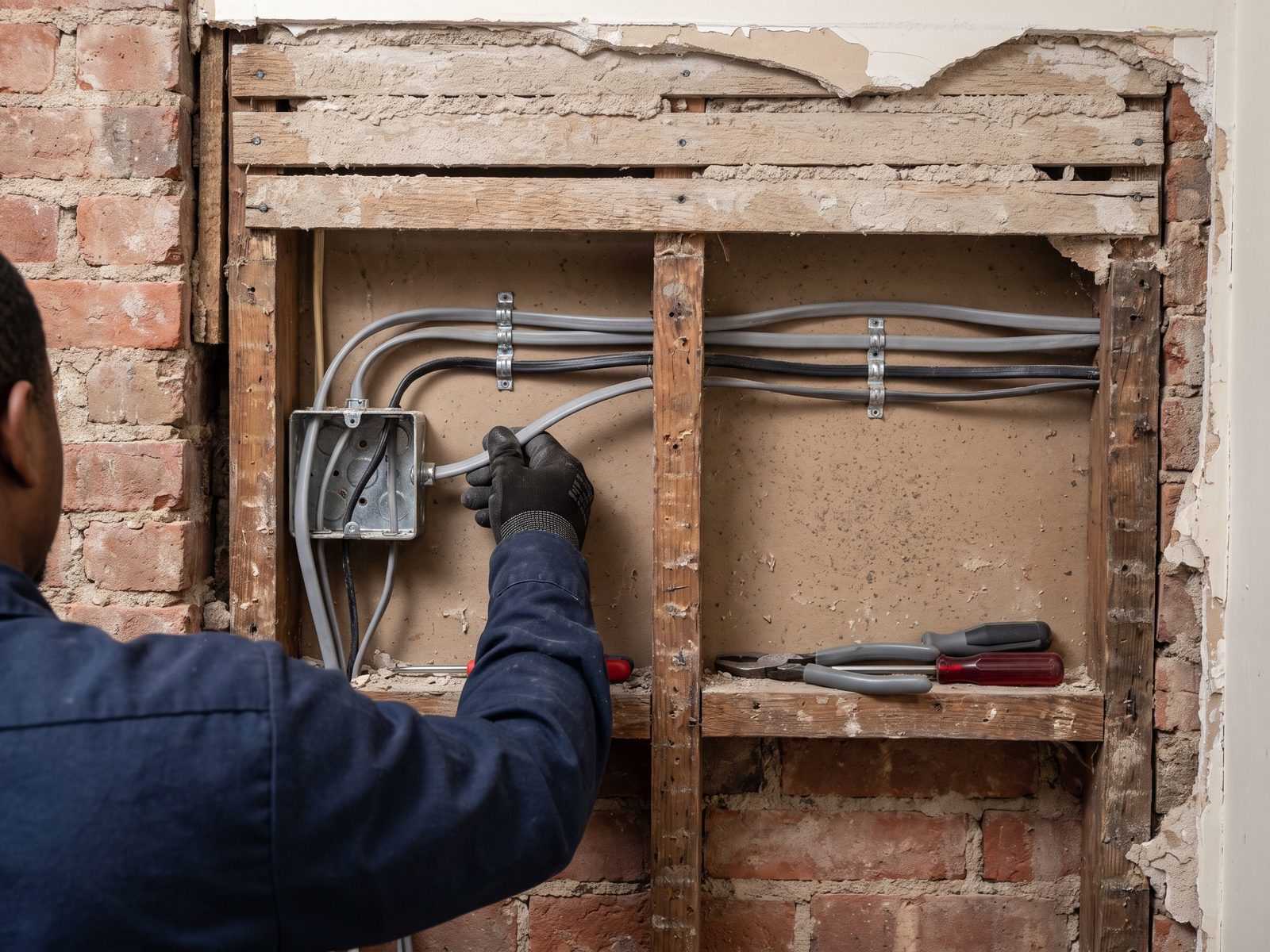
Water reaches electrical more often than people expect. A basement that took standing water may have submerged receptacles, a submerged panel or wet cable runs in the joist bays above. Corrosion at a terminal is not visible from the room.
The rule we work to is not ours: anything electrical that got wet is evaluated by a licensed electrician, and the work that follows is permitted work. We do not open panels, and no restoration company should. Plumbing is the same. A supply line, waste line, vent or water heater that has to be replaced or moved is a licensed trade pulling a permit.
For homeowners the practical effect is scheduling. Walls close after the rough-in is inspected, and a crew that closes one early can be told to open it again.
- Submerged receptacles, switches, panels or cable runs get an electrician's evaluation, not a dry-out and a hope
- Rough-in inspection happens with the wall open, so the drywall schedule follows the inspection
- Keep every inspection record; it is third-party proof the work was done to code
What triggers a permit when rebuilding a basement or below-grade space?
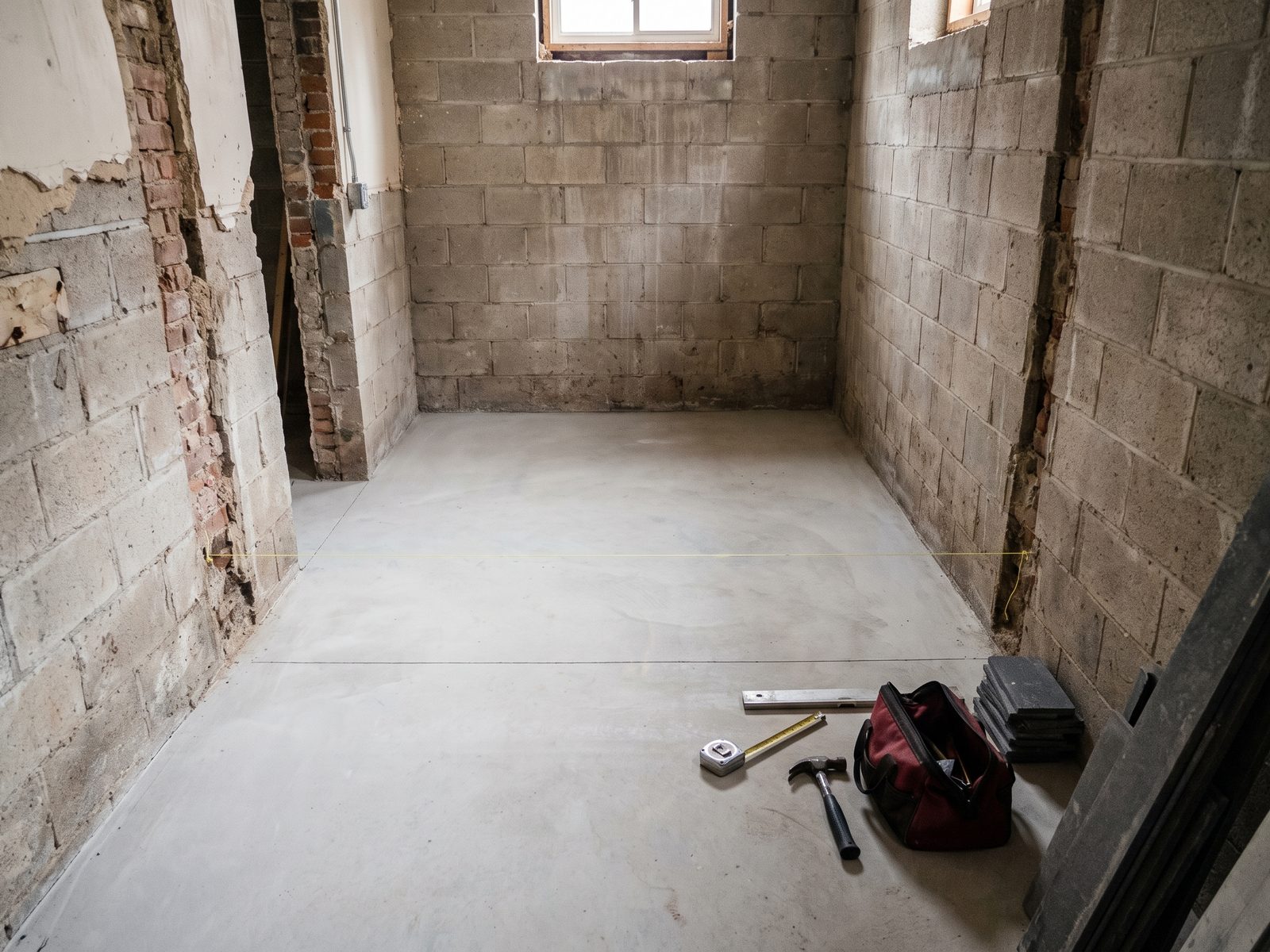
Below-grade space is where the permit triggers cluster, and the District has a great deal of it. English basements, cellars converted decades ago and rear additions dug out under a row house all sit in this category.
A basement put back exactly as it was, same partitions and same finishes, is closer to repair. A basement reconfigured while the walls are open is a rebuild, and rebuilds get reviewed. Owners often make that choice mid-project, because an open room is the cheapest time to move a wall.
Several things reliably pull a below-grade project into full review. New or relocated partitions. A ceiling dropped or raised. Changes at a stair. Work at an egress window or a well. Anything creating a bedroom where there was none. Separating a dwelling unit brings zoning and a certificate of occupancy into it as well.
Two agencies beyond DOB appear on these jobs. DOEE runs the District's mold program, which matters when a below-grade space has been wet long enough to grow something. DC Water is the authority for the sewer side, including the forms and standards that govern a backwater valve.
- Same layout, same finishes, nothing structural: closest to a repair
- New partitions, ceiling changes, stair changes or egress work: expect full review
- Creating a bedroom or a separate unit below grade: permit review plus zoning and occupancy questions
- A wet below-grade space also raises mold questions handled under the District's DOEE program
Who pulls the permit, and how long does it take?
The contractor performing the work should pull the permit, under their own license, for the trade the work belongs to. A permit names who is responsible, and the name on it should be the name doing the work.
DOB does allow a property owner to take responsibility on an application when no contractor has been selected yet, and asks that the contractor be added once one is hired. That is not an invitation to pull an owner permit so an unlicensed crew can work behind it. A contractor asking you to permit their work in your name is asking you to absorb their liability.
Restoration companies sit in an unusual spot. Mitigation is not permitted work, so the drying crew pulls nothing. When the same company handles the rebuild, those permits are theirs. Ask which entity holds the license and whether the trades are in-house or subcontracted.
Timing varies by permit type more than by anything else. A trade permit for a straightforward replacement moves quickly. A rebuild needing drawings and a plan review runs on a longer calendar, and a below-grade project with zoning questions is longer still. Mitigation, demolition and permit preparation can run at the same time.
What happens if the work is done without one?
Unpermitted work rarely blows up on the day it is done, and that is what makes it a bad trade. It surfaces later, when somebody with authority looks at the building, and by then the wall is closed and the contractor is gone.
Enforcement is what you would expect from any building department. A stop work order halts the job, a notice of violation follows with penalties attached, and the corrective path is to apply after the fact. That usually means opening finished work so an inspector can see behind it. Paying twice to build the same wall is the common outcome.
The quieter cost shows up more often than enforcement does. Work never inspected was never checked, and water losses hide the exact defects inspection catches: a junction box buried behind new drywall, a waste line with the wrong slope, framing replaced without anyone confirming what it carries.
If a contractor offers skipping the permit as a way to save you money, treat it as information about the contractor. The saving is real for them, because permitted work is inspected work.
How does an unpermitted repair affect your insurance claim or a future sale?
On the claim side the risk sits in the rebuild half. Most policies are written to return a property to its pre-loss condition, and the estimate is built from documented scope. Work done outside the permit system is harder to document and harder to defend when an adjuster or a reinspection challenges it.
One coverage provision is worth asking your carrier about, usually called ordinance or law coverage. It can respond when a code requirement drives a repair above simple replacement cost. It is not universal and the limits differ, so read your declarations page rather than anyone's summary. DISB handles complaints about how a carrier is treating a claim.
The sale is where unpermitted work most reliably comes due. Buyers ask. Their inspectors ask. A basement finished without a permit is a common negotiation item here, and an unpermitted bedroom below grade can change how the space is described in a listing. Legalizing it later, with finished walls in the way, costs more.
So keep the paper. Permit numbers, inspection records, mitigation documentation and moisture readings belong in one file. That file answers the question three years from now, whether a buyer, an adjuster or a lender is the one asking.
What should you ask a contractor before the work starts?
A short list of questions sorts this out, and all are fair to ask before signing. The answers tell you whether the company has done permitted rebuild work in the District or only mitigation.
None of it replaces asking the agency. DOB's permit wizard walks a scope through the questions that decide permit type, and contractor licensing sits with DLCP, where a license can be checked before a crew is on site.
We restore buildings and we rebuild them. We do not decide what your project needs; the Department of Buildings does. Anyone who tells you your job is exempt without checking is guessing with your money.
The agency pages and code text behind everything above:
- DC Department of Buildings: https://dob.dc.gov/
- DOB permit wizard: https://dob.dc.gov/page/dob-permit-wizard
- DOB permitting FAQs: https://dob.dc.gov/page/permitting-faqs
- The DC construction codes DOB enforces: https://dob.dc.gov/page/dc-construction-codes
- 2017 DC Building Code, Section 105.2, work exempt from a permit: https://dob.dc.gov/sites/default/files/dc/sites/dob/publication/attachments/2017%20District%20of%20Columbia%20Building%20Code_Part%201.pdf
- DLCP, for contractor licensing: https://dlcp.dc.gov/
- DOEE mold program for the District: https://doee.dc.gov/service/mold
| Ask this | What a straight answer sounds like |
|---|---|
| Which lines of this estimate need a permit? | A specific list, with the trade named for each, not a blanket yes or no |
| Whose license is the permit pulled under? | The company's own license, or the named subcontractor's, never yours |
| Are the electrical and plumbing trades in-house or subcontracted? | Either is fine, as long as the licensed trade is the one pulling and performing |
| When do the inspections happen relative to closing the walls? | Rough-in inspected with the wall open, drywall scheduled after |
| Will I get copies of the permit and the inspection records? | Yes, as a matter of course, without being chased for them |