Emergency Water Extraction in DC: What Happens in the First Visit

BYSteve Jafari, General ManagerWASHINGTON DC & SOUTHERN MARYLAND
Emergency water extraction in DC is the first-response step that removes standing water, maps hidden moisture in walls and floors, and sets up containment before structural drying begins. On the first visit, a technician confirms safety, stops the water source if possible, classifies the water category under the IICRC S500 standard, extracts the bulk water, documents everything with moisture readings and photos, and installs drying equipment. Restoration Doctor of Washington DC answers 24/7 at (202) 922-1444 across Washington, D.C. and Southern Maryland.
Call (202) 922-1444What is emergency water extraction in DC, and why does the first visit matter so much?
Emergency water extraction in DC is the rapid removal of standing and absorbed water from a property, followed by moisture mapping and containment to stop the damage from spreading. The first visit matters most because water keeps migrating every hour it sits — wicking up drywall, soaking into subfloor, and seeping between floor joists long after the visible puddle is gone.
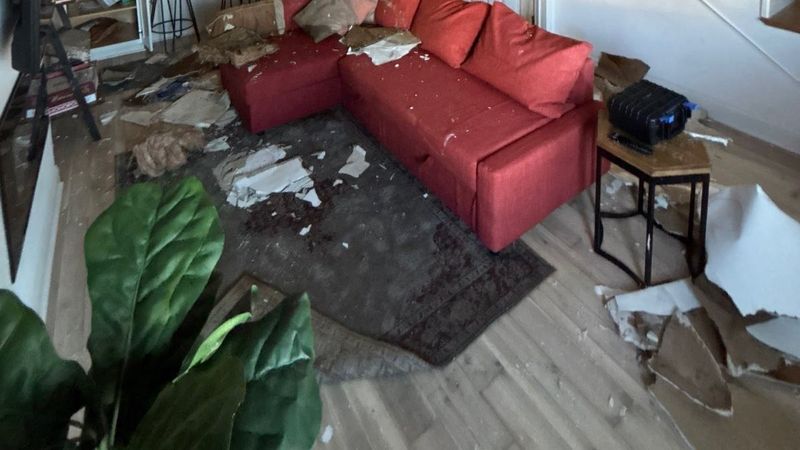
In DC's older housing stock, that migration is faster and harder to see. Row houses often share party walls where water travels laterally into a neighbor's structure. English basements sit partly below grade, so water pools at the lowest point and saturates masonry and framing. Condo and townhome stacks let water drop straight through ceilings into the unit below. The first extraction visit is where that spread is interrupted.
The goal of the first visit is not to finish the job. It is to remove the bulk water fast, measure exactly how far moisture has traveled, and establish the drying and containment plan that the following days will execute. Doing this correctly in the first few hours is what separates a clean dry-out from a mold problem weeks later. If you want a broader picture of what those early hours look like for a homeowner, our guide to the first 24 hours after water damage in DC walks through the same timeline from your side of the door.
How fast does Restoration Doctor respond to a water emergency?
Restoration Doctor of Washington DC provides 24/7 emergency response across Washington, D.C. and Southern Maryland — you can reach us at (202) 922-1444 at any hour, any day. Water damage does not wait for business hours, and neither does the first extraction visit.
Speed matters because water categories can change over time. Under the IICRC S500 standard, clean water (Category 1) can deteriorate to gray water (Category 2) and then to grossly contaminated black water (Category 3) the longer it sits and the more material it contacts. A fast first response keeps the loss in a lower, safer category that is simpler and less disruptive to remediate — more porous materials can be dried in place rather than cut out and discarded.
When you call, have a few details ready if you can: where the water is coming from, roughly how large the affected area is, whether you have shut off the source, and whether the water has reached any electrical panels or outlets. You can start the process any time at /contact or learn more about the full scope on our /services/water-damage-restoration page.
- Clean water (Category 1): from a sanitary source like a supply line, tub overflow, or falling rainwater — least contaminated
- Gray water (Category 2): from a dishwasher or washing machine discharge, or seepage under hydrostatic pressure — carries significant contamination
- Black water (Category 3): from sewage backups or flooding from rivers and ground surface water — grossly contaminated and handled under biohazard protocols
- The longer water sits, the more likely it is to deteriorate into a worse category
What is the first thing technicians do when they arrive?
The first thing a technician does on arrival is confirm safety and stop or verify the water source, then classify the water category before any extraction begins. Safety comes first because standing water near electrical systems, gas appliances, or a sagging, water-loaded ceiling is a hazard that has to be controlled before anyone wades in.
If the source is still active — a burst supply line, a failed water heater, an overflowing fixture — the technician works to stop it or confirms you have already closed it at the fixture valve or the main. There is no point extracting water while more is still arriving. In a DC row house, this sometimes means locating a shutoff in a shared or hard-to-reach utility space, so knowing where your main valve is ahead of time helps; our guide to finding the water shutoff in a DC row house covers the usual locations.
Next comes classification. The technician identifies the water category under S500, because that decision drives everything that follows: whether saturated materials can be dried in place or must be removed, what personal protective equipment is needed, and whether biohazard protocols apply. A clean-water pipe leak and a sewage backup can look identical on the floor, but they are handled very differently from the first minute of the job.
How is standing water actually extracted from a home?
Standing water is extracted using truck-mounted or portable extraction units with specialized wands that pull water from the surface and, critically, from inside carpet, pad, and other porous flooring. Mopping and shop-vacs only remove what is visible; professional extraction pulls water out of the materials that are holding it.
Extraction follows a sequence from the deepest standing water to the absorbed moisture in carpet and cushion. On hard surfaces, technicians squeegee and vacuum standing water. On carpet, they use weighted extraction tools that press water up and out of the pad. In an English basement where water has pooled against a below-grade wall, extraction concentrates at the low points where the water has collected, and the masonry behind it is checked carefully because brick and block hold moisture long after the floor looks dry.
Thorough extraction is also the single biggest accelerator of the drying phase. Every gallon physically removed by the extractor is a gallon the dehumidifiers never have to pull out of the air, which is why technicians keep extracting until the equipment stops recovering water rather than stopping when the floor merely looks clear.
How much water was removed and how far it spread are among the biggest factors in the overall project. Extraction does not have a single flat price — the work typically runs in the thousands depending on how much water there is, how many rooms it reached, and how much saturated material has to be removed. A precise figure comes only after an on-site inspection, because every DC property and every loss is different.
What is moisture mapping, and how does it find hidden water?
Moisture mapping is the process of measuring and documenting exactly how far water has traveled using moisture meters and thermal imaging, including into areas that look dry on the surface. It finds hidden water inside wall cavities, under flooring, behind baseboards, and above ceilings before that trapped moisture can feed mold growth.
Technicians use two main tools. Non-penetrating meters scan surfaces to detect elevated moisture without leaving holes, and penetrating (pin) meters take precise readings inside materials like drywall and wood framing. Thermal imaging cameras do not see water directly — they reveal temperature differences where evaporating water cools a surface, which helps map the edges of a wet area that the eye cannot see. Suspect areas flagged by the camera are then confirmed with a meter.
These readings are not a one-time snapshot. The technician establishes a drying goal by taking reference readings in comparable unaffected materials, records baseline readings in everything that is wet, and then tracks progress against that dry standard throughout the job. In a row house with a shared party wall, moisture mapping is what reveals whether water has crossed into the wall assembly between units — something a visual inspection alone would miss.
Every reading is documented. Restoration Doctor provides the homeowner with daily moisture logs, CompanyCam photo documentation, and an Xactimate scope, so you have a clear written record of what was wet, what was dried, and what was removed.
Why is containment set up on the first visit?
Containment is set up on the first visit to stop water vapor, humidity, and potential contaminants from spreading into unaffected parts of the home while drying is underway. Without it, the elevated humidity created during drying can migrate and cause secondary damage in rooms the original water never touched.
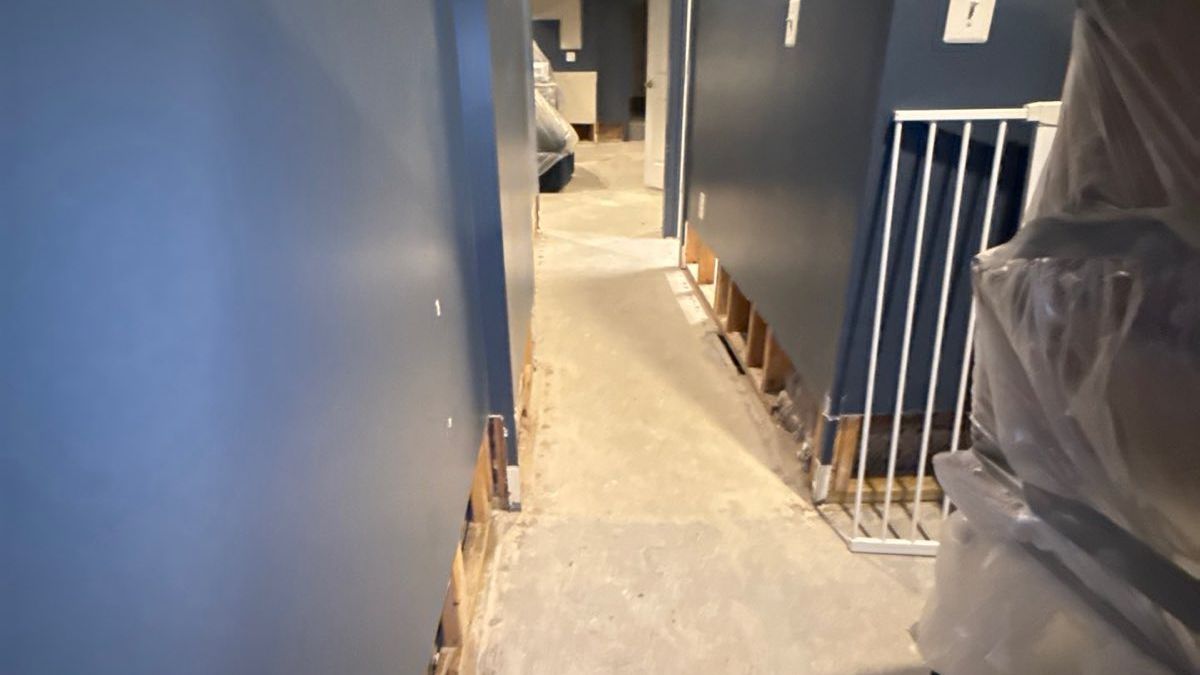
Containment usually means sealing off the work area with polyethylene sheeting and, where needed, running negative air pressure with air filtration devices that scrub the air and keep contaminated or humid air from drifting into clean spaces. For Category 2 and Category 3 losses, containment is not optional — it is part of the required protocol to protect the rest of the property and its occupants.
In DC condos and stacked townhomes, containment also protects neighboring units. Because water and humidity travel through shared walls, floors, and ceilings, controlling the affected zone protects both your space and the units around and below you. If the water came from a sewage backup, these controls follow Category 3 biohazard protocols; you can read more about that on our /services/sewage-cleanup page.
- Polyethylene sheeting seals the work area from the rest of the home
- Air scrubbers filter airborne particles and reduce cross-contamination
- Negative air pressure keeps humid or contaminated air from escaping the zone
- Containment protects neighboring units through shared row-house and condo walls
When does drying equipment go in, and what gets installed?
Drying equipment goes in at the end of the first visit, immediately after extraction and moisture mapping, so the structure starts drying right away. Technicians install air movers to accelerate evaporation at wet surfaces and dehumidifiers to pull that evaporated moisture out of the air before it can resettle into cooler materials elsewhere in the home.
Equipment placement is based on psychrometry — the relationship between temperature, humidity, and airflow that governs how a structure dries. Air movers are positioned to sweep air across wet surfaces at the right angle and spacing, while dehumidification capacity is matched to the volume of the space and the amount of moisture in the materials. In a damp DC English basement, where ambient humidity is already high for much of the year, dehumidification carries much of the load, and getting the sizing right is the difference between a steady dry-down and a stalled one.
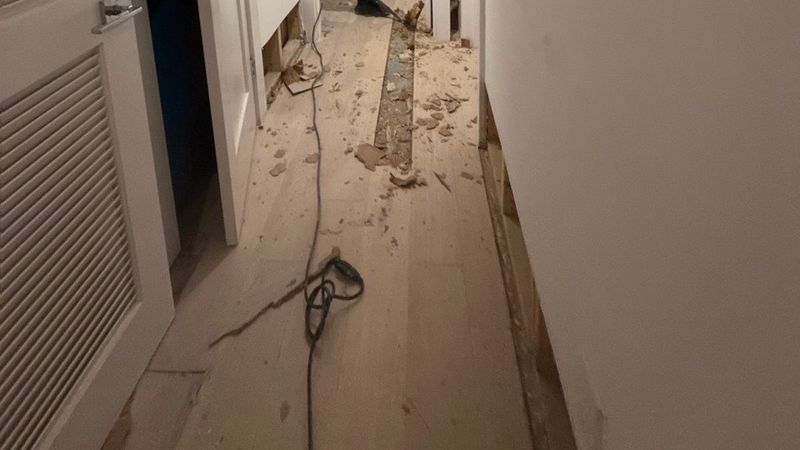
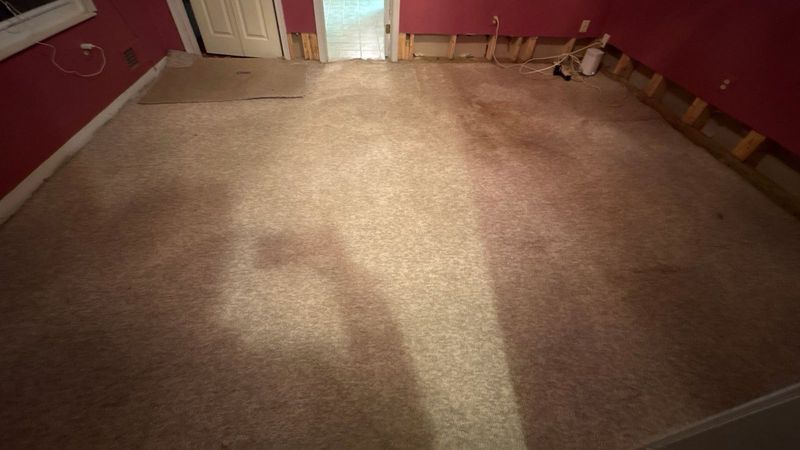
Sometimes materials cannot be saved. Saturated carpet pad, swollen baseboards, or drywall that has wicked water high up the wall may be removed so the cavity behind can dry. This is a judgment call made from the moisture readings and the water category, not guesswork — the goal is always to dry in place what can be dried and remove only what truly must go.
How long does structural drying take, and how do you know it's done?
Structural drying runs until moisture meters confirm the affected materials have returned to the established drying goal, and that endpoint is determined by measurement — not by a fixed number of days. The equipment stays in place and is monitored until the readings prove the structure is dry.
During the drying phase, a technician returns to record moisture readings, check equipment performance, and adjust air mover and dehumidifier placement as conditions change. These daily moisture logs show the downward trend as materials release their water. The job is finished when the previously wet materials match the dry standard established at the start — and you receive those logs as part of your documentation.
How long this takes depends on real variables: how much water there was, what materials are involved (hardwood, plaster, and masonry hold moisture far longer than drywall), how well the space holds temperature and airflow, and the ambient humidity of the DC season. Rushing this step is how mold problems start, which is why the standard is a measured dry endpoint rather than a calendar date. If elevated moisture has already led to visible microbial growth, our /services/mold-remediation team addresses it under the IICRC S520 standard.
Who pays for emergency water extraction, and how does insurance fit in?
Restoration Doctor is hired by and invoices the homeowner directly under a written agreement, and we hand you the documentation you need for your insurance claim. We do not interpret your policy, negotiate with your insurer, or represent you in the claim — that relationship stays between you and your carrier.
What we do provide is thorough, claim-ready documentation: an Xactimate scope of the work, CompanyCam photo documentation of the damage and the restoration, and daily moisture logs proving the structure was dried to standard. Homeowners submit this package to their insurer themselves, and it gives the adjuster a clear, professional record of exactly what happened and what was done.
Cost depends on the scope of the loss — how much water, how far it spread, how much material had to be removed, and how many days of drying were required. The work typically runs in the thousands, and an accurate number comes only after an on-site inspection. Restoration Doctor of Washington DC is licensed in the District under DC DLCP #410524000721. For more on documentation and the claims process, see our /faq, and when you need help right now, reach us at /contact or call (202) 922-1444.