Who Is Responsible for the Water Line in DC? Supply Lines and Laterals
BY RESTORATION DOCTOR OF WASHINGTON DC · WASHINGTON DC & SOUTHERN MARYLAND
DC Water pays for work in public space and the owner pays for work on private property, and on the sewer side the utility puts maintaining the service line and clearing the lateral on the owner. A standard homeowners policy usually pays for the water damage inside and not for the pipe outside, which is why the endorsement names matter more than the coverage summary.
Call (202) 922-1444Where does DC Water's responsibility stop and yours begin?
Responsibility splits into a public side and a private side, and DC Water draws that line at the boundary between public space and private property rather than at your front wall. On the water side, DC Water's lead replacement pages say the utility pays for work in public space and the property owner pays for work on private property. On the sewer side, DC Water's sewer backup page is blunter: the property owner is required to maintain the sewer service line and remove clogs in the lateral. So the honest answer to who is responsible for the water line in DC is both of you, in sequence.
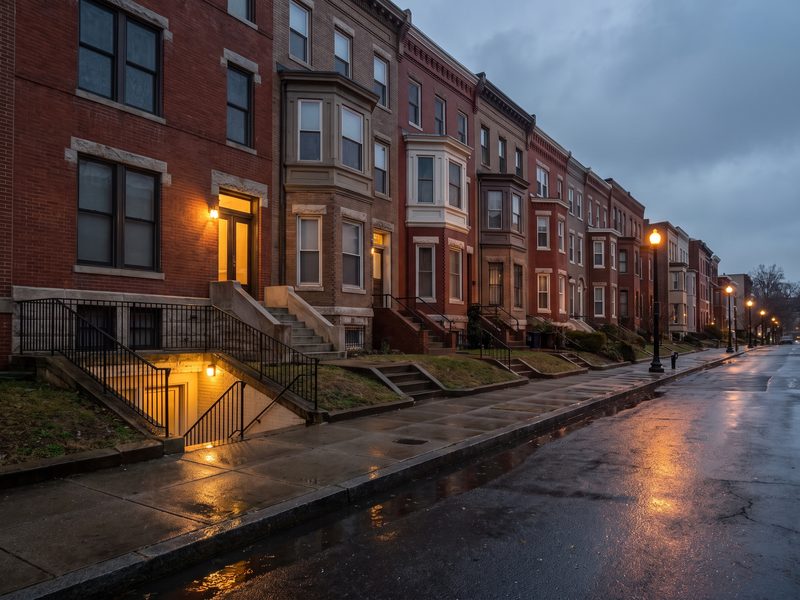
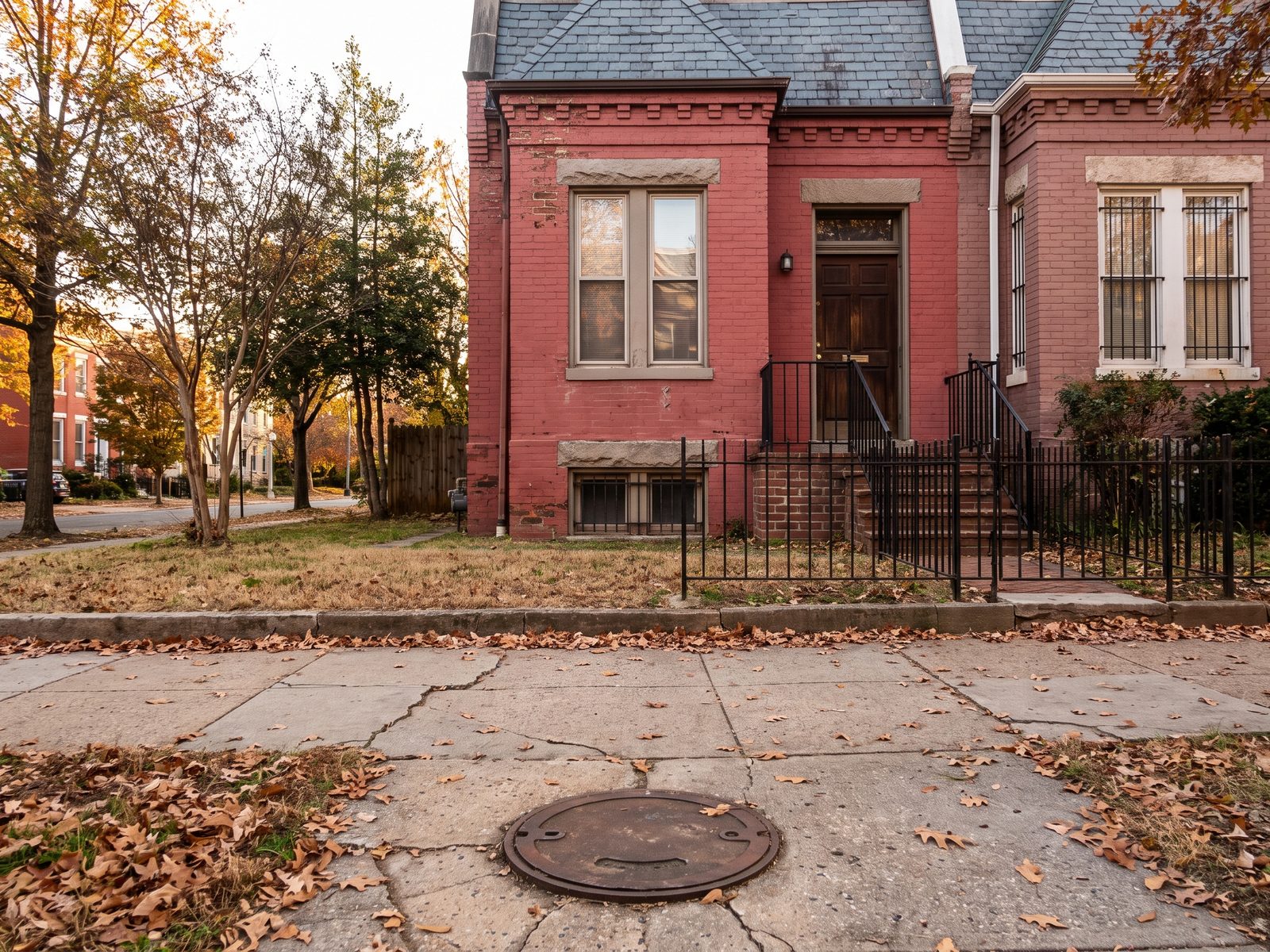
Public space is the part that trips people up. In a District row house the sidewalk and the planted strip in front of your door are public space, not your yard, even though the pipe running under them is the one you are expected to repair and pay for. That is why so many owners assume the utility owns everything up to the porch steps. It does not.
The first question on a broken pipe is not what it costs. It is whose pipe broke, because that decides whether you open a ticket with the utility or hire a plumber.
Is the answer the same for the water supply line and the sewer lateral?
No, and assuming it is causes most of the confusion. The water supply line and the sewer lateral are described on different DC Water pages, and they do not say the same thing. The supply-side split appears on the utility's lead replacement pages, framed as work in public space versus work on private property. The sewer side appears on DC Water's sewer backup page, which puts maintenance of the sewer service line and clearing of clogs in the lateral on the property owner. That page also refers to a public portion of the lateral that the utility handles. Treat those two pages as the authority and never a neighbor's memory of a repair from years ago.
The meter is the landmark owners reach for on the supply side, because it is the one part of the run you can see, but it is the utility's equipment and not by itself the boundary. On the sewer side there is no meter and no valve, only a cleanout.
| Water supply line | Sewer lateral | |
|---|---|---|
| What it does | Carries potable water from the public main into the building | Carries waste from the building out to the public sewer |
| Utility side | The main in the street and the work in public space, per DC Water's lead replacement pages | The public sewer main and the public portion of the lateral, per DC Water's sewer backup page |
| Owner side | The work on private property, into and through the building | Maintaining the sewer service line and clearing clogs in the lateral, cleanout included |
| Visible landmark | The meter box, useful as a landmark but not itself the boundary | None above ground; the cleanout is the only access point |
| First signs of failure | Wet ground, a jump in usage, low pressure at the fixtures | Slow drains, gurgling, backup at the lowest fixture, odor |
| Typical repair path | Excavation under permit, or a trenchless pull | Spot repair, pipe lining, or full replacement under permit |
Who pays to dig up the public space between the curb and your wall?
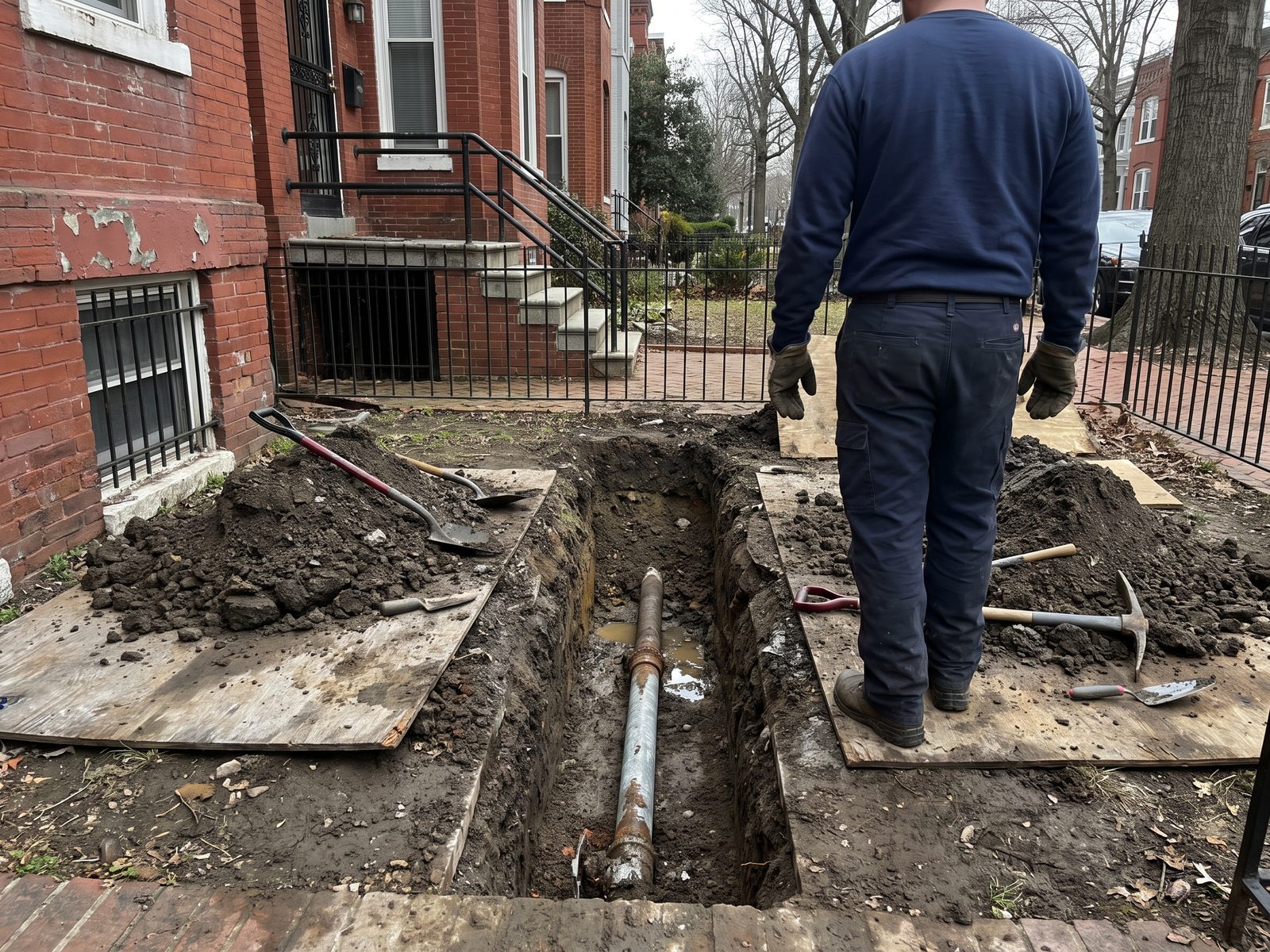
The side of the boundary the failure sits on decides who pays for the dig, and in a row house that boundary usually falls under ground you do not own. The sidewalk and the planted strip are public space. The pipe under them can still be yours, which is why the first money you spend should go to locating the fault rather than to opening the ground.
That is also why a quote for the same broken pipe varies so widely across the District. The pipe itself is a small part of it. Expect permits for work in public space, pedestrian control on a narrow street, protection for a street tree, and restoration of sidewalk or roadway on top of the plumbing.
Do not dig in public space yourself, and do not let anyone dig there for you without the permits in hand. Unpermitted work in the right of way turns a plumbing bill into an enforcement problem. Hire the licensed contractor and let them pull the permits.
What are the first signs each of these lines is failing?
Both pipes warn you before they fail outright, but they warn you in different languages. A supply line talks about pressure and water where water should not be. A lateral talks about drainage, air and odor. Knowing which one you are hearing saves a week chasing the wrong trade.
Supply side first. Pressure drops at the top-floor fixtures while the ground-floor tap still runs strong. The meter keeps creeping with every fixture in the building shut off. A patch of the front strip stays soft and green through a dry stretch, or a thin line of clear water tracks down the gutter from nowhere. Water that appears without rain is a supply story until proven otherwise.
Sewer side next. Several drains slow at once rather than one. A toilet on the lowest floor bubbles when the washer discharges. The floor drain smells when the weather turns warm. Roots find a cracked clay or cast-iron joint and grow into it, and the lateral works fine for years afterward until the first heavy solid load hangs up on the mass.
Our sister site restorationdoctors.com goes further into why laterals fail on tree-lined streets, at https://restorationdoctors.com/blog/sewer-lateral-failure-northern-virginia, and the failure mechanics there are the same ones that show up under a District sidewalk.
- Supply line: usage climbing on the bill with no change in habits, or the meter dial moving with the house quiet.
- Supply line: soft, sunken or persistently wet ground between the sidewalk and the building front.
- Sewer lateral: more than one fixture draining slowly, especially the lowest ones in the building.
- Sewer lateral: gurgling from a tub or toilet when a different fixture is used, meaning air cannot get past a restriction.
- Either line: a sinkhole, a dip in the sidewalk, or settling paving over the run of the pipe.
Does homeowners insurance cover a broken service line or lateral?
Read the policy as two separate questions. One is whether the carrier pays to repair the buried pipe. The other is whether it pays to dry and rebuild what the failure damaged inside. On a standard form the usual answer is no to the first and yes, within limits, to the second.
Wear, rot and gradual deterioration are typically excluded, and a pipe that spent decades in wet soil is the textbook example. The water damage inside is a different peril from the pipe itself, and many forms pay for that even where the failed component is excluded.
Sewage is its own category again. Water that comes back up through a drain is usually excluded on the base form and covered only when a backup endorsement is named on the declarations page. An owner can have a covered supply-line rupture in one room and an uncovered backup in another during the same week.
Never take a coverage answer from a summary page or a contractor's confidence. The District's Department of Insurance, Securities and Banking publishes consumer guidance and takes complaints if a carrier's answer never arrives.
What is a service-line endorsement and how is it different from water backup coverage?
These are two different add-ons, and they solve opposite halves of the problem. A service-line endorsement is about the pipe. A water backup endorsement is about what comes out of the pipe and into the house.
A service-line endorsement is written to pay toward repair or replacement of the underground utility lines you are responsible for, and depending on the form it can reach excavation and surface restoration too. Limits are modest, often a fixed amount rather than the full dwelling limit, with a separate deductible.
A water backup or sewer backup endorsement pays for damage inside when water backs up through a drain or a sump discharge fails. It does not repair the lateral. Buy one without the other and you are covered for half of a lateral failure.
Both have to be added before a loss. Ask your agent for the endorsement form numbers, then confirm those numbers appear on your declarations page at renewal. A verbal yes is not coverage.
Who do you call first: DC Water, a plumber, or a restoration crew?
Call the utility first when the evidence points to the public side or when you cannot tell. DC Water can check the meter, investigate water surfacing in the street or the strip, and tell you whether what you are seeing is theirs. Ask what the visit covers and whether anything is billable before you book it. Either way, get the ticket number, because it establishes a record with a timestamp that matters if the cause turns out to be the main.
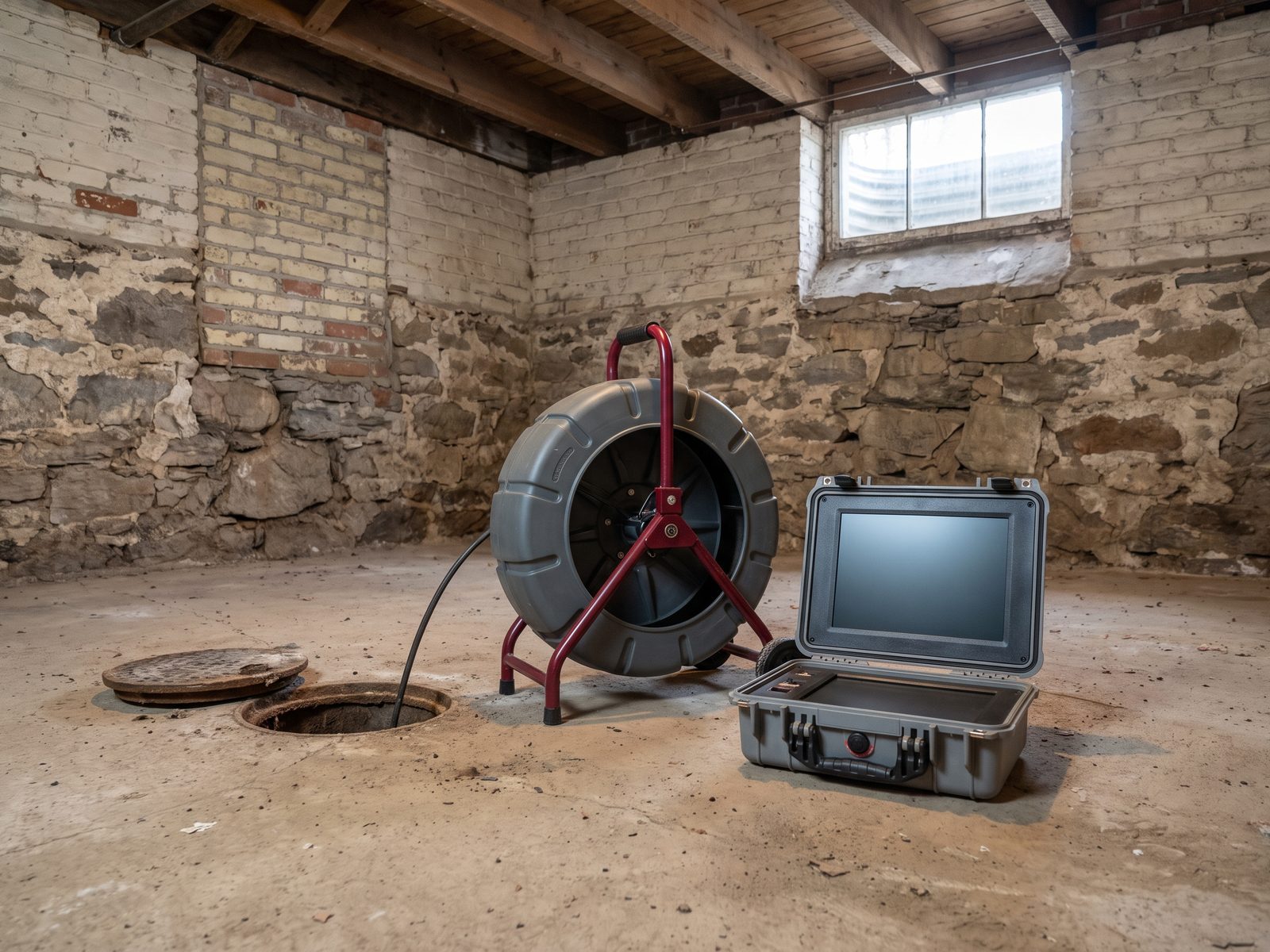
Call a registered master plumber when the utility rules out the public side, when drains are slow, or when a camera run is the only way to see what is happening. That is DC Water's own requirement for clearing a lateral, and the cost sits with the owner. The plumber locates the fault, tells you which side of the boundary it sits on, and prices the repair. Get the camera footage; it is your evidence for both the carrier and the contractor.
Order of operations when sewage is involved: stop the source, keep people and pets off the affected floor, cut power to wet circuits if the panel is safe to reach, then get both trades moving.
What does the interior damage side of a lateral failure look like?
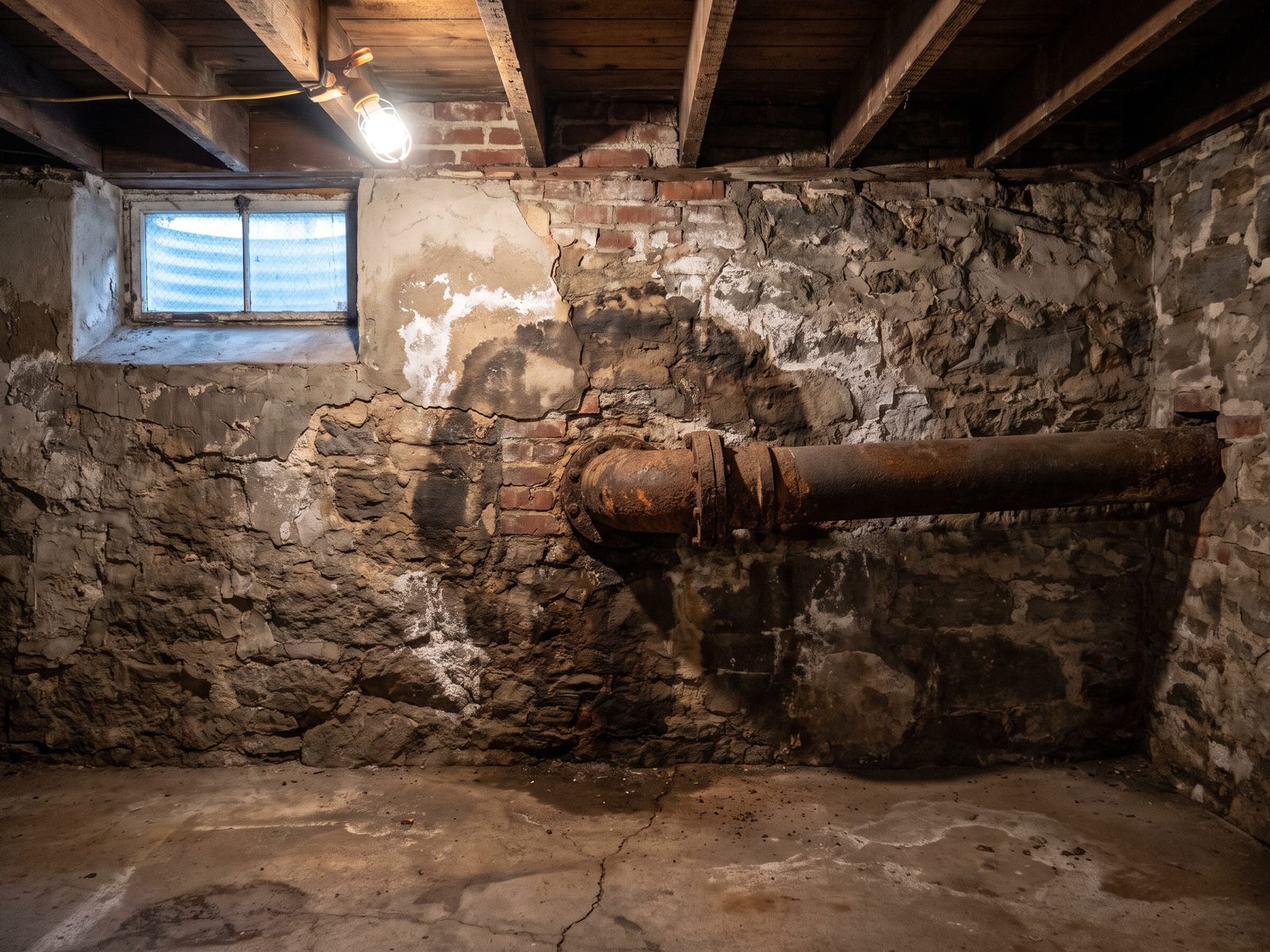
A supply-line break floods. A lateral failure seeps, and that difference shapes the whole repair. Clean water under pressure announces itself in minutes. Waste escaping a cracked lateral can wet the soil under a slab for months before anything shows on the floor above it.
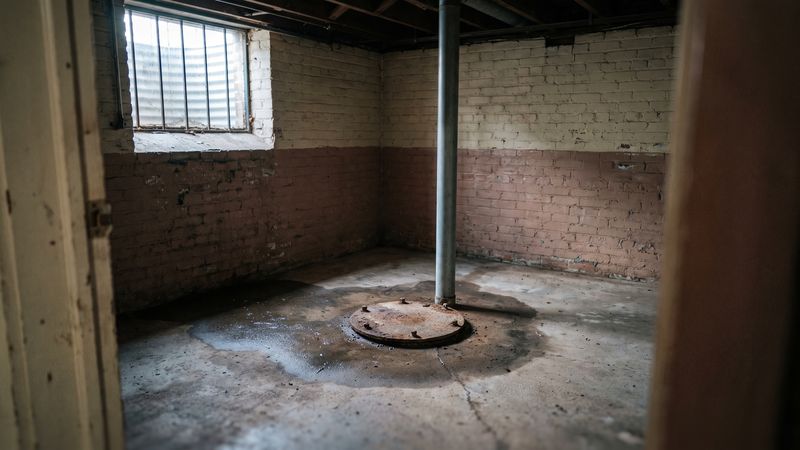
In a below-grade room the first evidence is usually at the edges. A damp halo on masonry where the pipe leaves the foundation wall. Efflorescence creeping up the block. Baseboard that has darkened and swelled at the bottom inch while the wall above it reads dry. We pull that baseboard first, because the cavity behind it tells the truth the surface will not.
Then the meter comes out. A pin meter in the framing and a non-invasive scan across the slab map how far the moisture actually travelled, which is almost never where the stain is. In an English basement apartment all of it hides behind a clean painted wall, and the smell arrives before the stain does.
Odor is the other tell. Sewage odor that returns every time the room warms up means contaminated material is still in place, typically wet insulation, subfloor or the bottom of a stud bay. Deodorizing around it buys a few days and nothing more.
How does a lateral failure change the water category inside the house?
Water is classified by what is in it, not by how much of it there is. The IICRC S500 standard sorts losses into three categories, and a sewer lateral failure starts at the worst one. Category 3 water is grossly contaminated, and anything out of a waste line belongs there from the first minute.
The practical effect is that porous materials do not get dried in place. Carpet and pad, wet drywall, insulation, particle board and most finished flooring come out and go in a bag. Semi-porous and non-porous surfaces get cleaned, treated with an appropriate antimicrobial and then dried, with containment and negative air keeping the work area from contaminating the rest of the building.
Category also drifts with time. Clean supply water left standing in a warm basement degrades toward Category 2 and then Category 3 as it picks up soil and feeds bacterial growth. Every day of delay moves the loss up a category and moves the scope from drying toward demolition.
What can you do now to find out which pipe you have?
Do this on a dry weekend rather than during an emergency. Find the meter box in the sidewalk or strip and note whether the lid is accessible. Find the sewer cleanout, usually a capped fitting in the front yard or the basement floor.
Then establish the age and material. A building from the first half of the last century probably still has some original cast iron or clay in the ground, and a mid-century replacement may have used the tar-impregnated fiber pipe that deforms as it ages. A camera inspection answers the question in a single visit and gives you footage to keep.
Finally, close the paperwork gaps. Ask DC Water to confirm where its responsibility ends for your address in writing. Ask your insurer in writing whether a service-line endorsement and a backup endorsement are on the policy, and what each one limits. Put both answers in the same folder as the camera footage.
If contaminated water is already inside, stop the source and get a crew in to extract and contain. Sources for the standards and agencies named above are listed below.
- IICRC, the body that publishes the S500 water damage restoration standard: https://www.iicrc.org/
- EPA guidance on cleaning up mold after water damage in a home: https://www.epa.gov/mold/mold-cleanup-your-home
- DC Department of Insurance, Securities and Banking, for policy questions and complaints: https://disb.dc.gov/complaints
- DC Water's Lead Free DC replacement pages, on the split between work in public space and work on private property: dcwater.com/resources/lead/partners-removing-lead/replacelead
- DC Water's sewer backup page, on the property owner's duty to maintain the sewer service line and clear the lateral: dcwater.com/resources/emergencies/sewer-backup