Who Pays the Restoration Company in DC: Your Invoice, Your Deductible, Your Lender

BYSteve Jafari, General ManagerWASHINGTON DC & SOUTHERN MARYLAND

Coverage depends on your policy and your insurer's decision. We invoice the property owner, and you are responsible for payment under your signed agreement, whether or not your insurer pays. Questions about coverage belong with your insurer, your agent, or a licensed public adjuster or attorney.
Call (202) 922-1444Who is actually the restoration company's customer: you or your insurer?
Who pays the restoration company? The property owner does. We are hired by the property owner under a written agreement, and we invoice the property owner. We do not represent you in your claim. Many owners who call after a burst supply line assume the insurance company hires the crew. It works the other way around.
The practical effect is that you, not an adjuster, decide who works in your home. You can also end the relationship or ask for a different scope. The invoice comes to the property owner either way.
In the District the ownership question gets layered. A row house on Capitol Hill has one owner. A condo in Navy Yard or a co-op off Dupont Circle has an owner and an association or corporation. Coverage depends on your policy and your insurer's decision. On a multi-unit loss we establish in writing who is authorizing which part of the work.
What does the work authorization you sign on day one commit you to?
The work authorization is the contract. It is usually one or two pages, it is signed at the kitchen table while extraction equipment is still coming off the truck, and it is the document that determines who owes what when the drying is done. Read it before you sign it, even at two in the morning, because everything that follows is measured against it, and anything that changes later has to be put in writing too.
A work authorization should state who the customer is, who is responsible for the balance, and how emergency mitigation is priced. Ask us to explain anything in it that you do not understand.
- Who the customer is, stated in plain language, and who is responsible for the unpaid balance
- The scope of the emergency phase: extraction, containment, equipment, monitoring, and what ends it
- How pricing is derived
- What documentation you receive: photos, daily moisture readings, the drying log, and the final estimate
Where does the deductible come in, and when do you pay it?
Your deductible is a term of your own insurance policy, and it is between you and your insurer. We invoice the property owner. You are responsible for payment under your signed agreement, whether or not your insurer pays. Payment terms are set out in your written agreement.
Payment for the work does not wait on your insurance. Whatever your insurer reimburses you is settled between you and your insurer. Questions about how your deductible applies belong with your insurer or agent.
Condo and co-op owners may also face charges from the association or corporation. Pull the association declarations and the bylaw section on insurance, and ask your agent how your own policy treats such charges.
What documentation do you receive from us?
We provide project documentation to you: dated photographs, daily moisture readings, the drying log and an itemized invoice. You may share it with your insurer. If your insurer requests our records, we provide them with your permission.
Your insurer alone decides what it approves and pays. Coverage depends on your policy and your insurer's decision. Questions about coverage belong with your insurer, your agent, or a licensed public adjuster or attorney.
Why might my mortgage company be involved?
If you have a mortgage, your lender may have requirements of its own after a loss. The Consumer Financial Protection Bureau publishes consumer information on this subject, linked in the sources at the end. Call your servicer and your insurer to ask what applies to you.
Mitigation is usually finished and invoiced long before a reconstruction schedule begins. Telling us at the start that a servicer is involved lets everyone set realistic dates.

What if the scope grows after the first inspection?
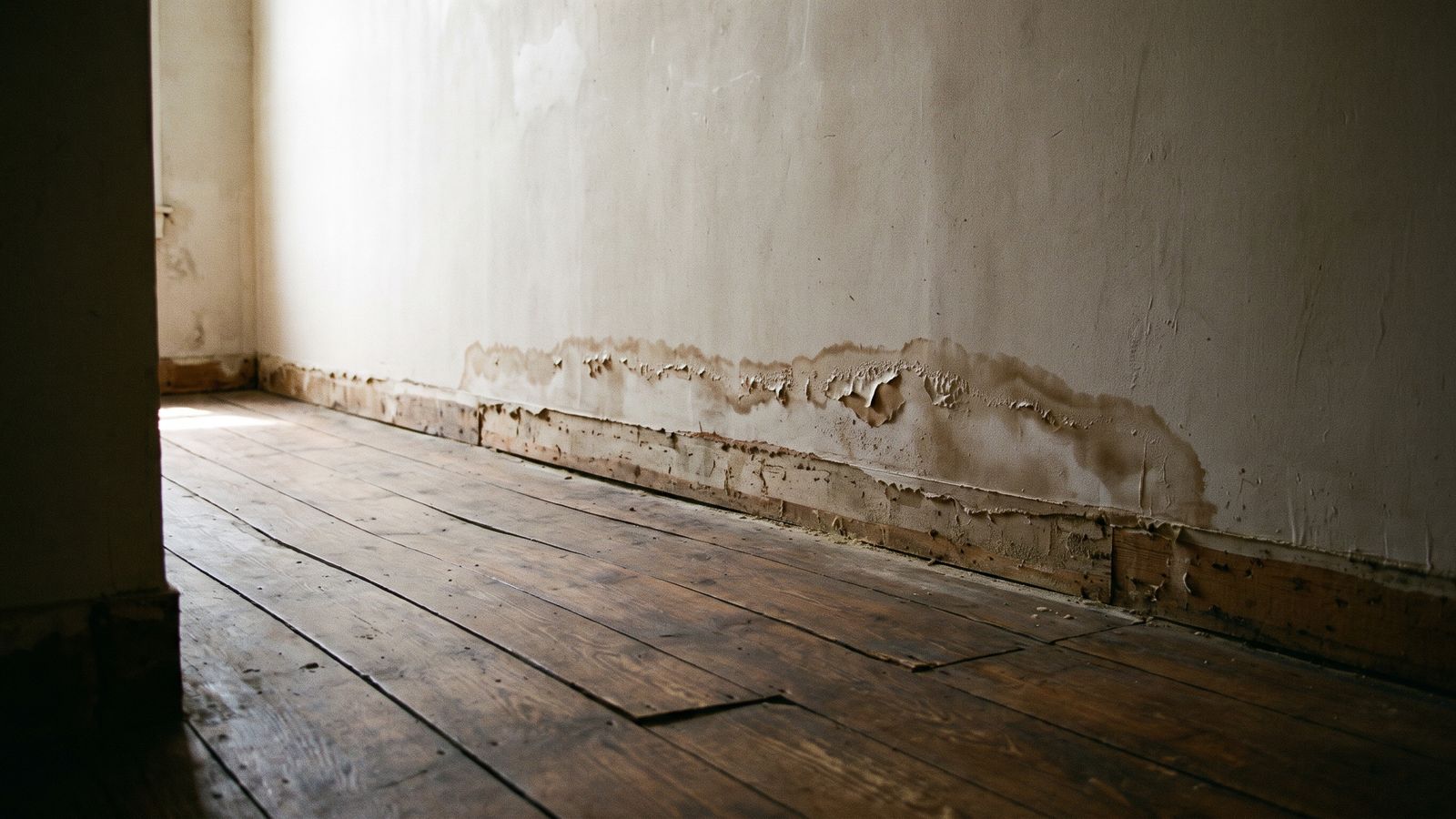
Water can track under a subfloor, into a vanity or behind a party wall where nobody could see it on day one. We pull the baseboard, set the pins of a moisture meter into the bottom plate, and log what it reads against the day before. If the readings change what the work needs, we document that with dated readings and photographs of the open cavity, tell you, and update the scope in writing under your agreement.
This is one reason the drying documentation matters as much as the drying itself. It follows the inspection and monitoring practices set out in the ANSI/IICRC S500 standard.
Who can I ask if I disagree with my insurer?
The contract for our work is between the property owner and the restoration company, and the insurer is not a party to it. The invoice remains the property owner's responsibility under the written agreement.
Questions about your insurer's decisions belong with your insurer, your agent, or a licensed public adjuster or attorney. The District of Columbia Department of Insurance, Securities and Banking takes consumer complaints about insurers licensed in the District, and its consumer pages are linked at the end of this article.
What does the sequence look like end to end?
Laid out in order, our side of the sequence is less confusing than it feels in the middle of a loss. The single most useful habit is keeping one folder, digital or paper, holding the claim number if you have one, every estimate version, every invoice and every payment.
Sources referenced in this article:
- ANSI/IICRC S500 Standard for Professional Water Damage Restoration
- District of Columbia Department of Insurance, Securities and Banking, insurance consumer information
- District of Columbia Department of Buildings, how to get a permit
- Consumer Financial Protection Bureau, how home insurance companies pay out claims
| Stage | Who acts | What happens | What to have ready |
|---|---|---|---|
| Loss discovered | Owner | Owner calls us and decides whether to notify an insurer | Policy information if you have it, date and cause of loss, first photographs |
| Emergency mitigation | Restoration company | Extraction, containment and drying equipment go in | Signed work authorization, building access, power on |
| Inspection and scope | Restoration company | Estimate written from measured conditions | Moisture readings, photographs, affected material list |
| Documentation | Restoration company | Project documentation provided to the owner | Final drying log and itemized invoice |
| Mitigation invoice | Owner | Drying invoice settled by the owner under the written agreement | Invoice and payment terms from your agreement |