Leaves, Areaways and Flat Roofs: A DC Fall Checklist That Prevents Winter Water
BY RESTORATION DOCTOR OF WASHINGTON DC · WASHINGTON DC & SOUTHERN MARYLAND

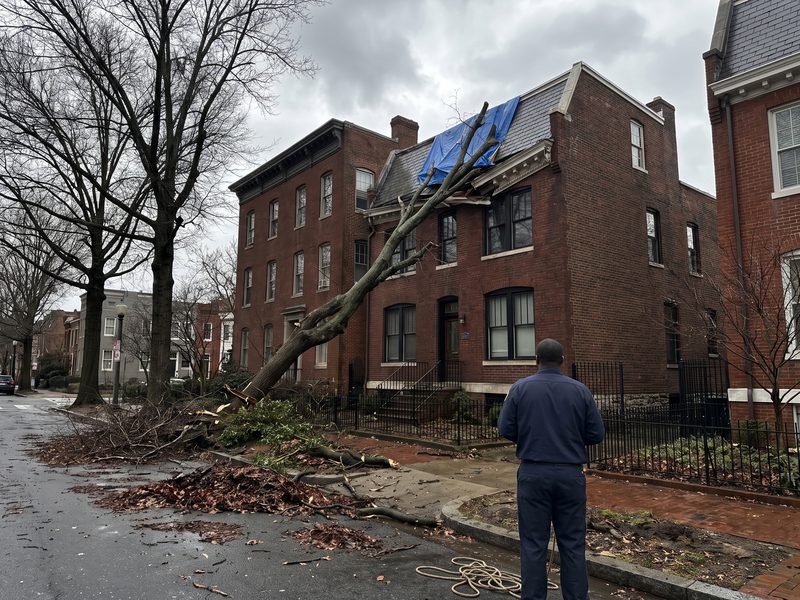
A DC row house fails in autumn at the flat roof drain, the areaway drain, the parapet flashing and the unheated basement, and every one of those is cheap to fix in October and expensive in January. Work the list once, photograph what you find, and the winter claim you do file will be straightforward.
Call (202) 922-1444Why does a DC row house need a different fall checklist than a suburban house?
A fall home maintenance checklist for a DC row house is not the suburban list with the address swapped, and the water damage it exists to prevent starts in places that list never mentions. The row house drains through the middle of its own flat roof instead of off an eave, and it sends ground water to one small drain at the bottom of a stairwell instead of across a graded lawn. Nine things have to be right before the first hard freeze, and four of them do not exist on a detached house at all.
The shape of the building changes the list. Two party walls mean no side yard and no grade to push water away. A parapet hides the only visible sign of a failed seam. Heat often comes from a boiler standing in a basement nobody heats on purpose, and the lowest floor is frequently living space rather than storage.
For the general pattern behind the seasons, our sister site restorationdoctors.com maps out which loss peaks in which month at https://restorationdoctors.com/blog/northern-virginia-water-loss-calendar. Read that as the background and treat the list below as the row house layer on top of it.
Here is the whole checklist in order. Work it once in October, then repeat items one and four after the last leaves come down.
- 1. Book a roofer to clear the flat roof drains and any scupper and confirm each strainer dome is seated.
- 2. Have a roofer look at the membrane seams, the drain collar and every pipe or vent penetration boot.
- 3. Ask the same roofer or a mason to check the parapet cap, the coping joints and the counterflashing.
- 4. Rod and flush the areaway drain at the bottom of the front or rear basement stairwell.
- 5. Clear window wells and the door threshold at the English basement entrance, including the grit under the mat.
- 6. Shut the interior valve feeding every hose bib, then open the spigot outside and let the line drain.
- 7. Insulate the exposed water lines running along joists and the rim of the unheated basement.
- 8. Service the boiler or furnace and set the lower level to hold well above freezing all winter.
- 9. Find the main water shutoff, confirm it actually turns, and label it so anyone in the house can use it.
What has to happen to the flat roof and its internal drains before leaf fall ends?
A flat roof in the District usually drains through one or two internal drains, sometimes with a scupper cut through the parapet as the backup. There is no gutter to clean, which is exactly the problem. Leaves do not slide off an edge. They travel across the membrane with the water and stack against the only opening the roof has, and once that opening closes the roof holds every drop that lands on it.
Treat it as a two visit job rather than one. The first pass happens when the neighbors' trees are half bare, usually mid to late October. The second happens after the last drop, because a drain cleared in October fills again in November. Oaks in particular hold their leaves late, so a roof cleared in October is rarely still clear in December.
Do not climb up and do this yourself. These roofs are low slope but they end at a parapet with a drop to an alley or a neighbor's roof, and an aged membrane tears under a heel. Send a roofer instead. Ask them to lift each strainer dome, pull the debris out of the drain bowl by hand, and run a hose long enough to prove the water actually leaves the roof.
Why is the areaway drain the single highest-consequence item on the list?
Because it is the only drain the areaway has, and what sits behind it is living space. An areaway is the sunken stairwell at the front or rear of a row house that drops to the basement door. It has walls on three sides and a door on the fourth. When the drain at the bottom stops, that stairwell becomes a tank, and the water finds the underside of the door within minutes.
This one repeats every autumn in Petworth, Columbia Heights, Bloomingdale and on the Hill. The drain is small, it sits at the bottom of a leaf funnel, and it usually ties into an old line already narrowed by grit and root fiber. A single heavy storm on a blocked areaway drain can put standing water across a finished lower level floor.
Test it before you need it. Run a hose into the drain for two or three minutes and watch the water level at the grate. If the level rises at all, the line is restricted and a drain contractor should rod it now. Lift the grate as well, because the trap under it fills with compacted leaf mulch that a hose alone will not move.

What do you do about a parapet and its flashing before winter?
The parapet is the low wall that carries the roof edge past the roof surface, and in a row house it is the part most likely to leak without anyone noticing. Water enters at the coping joints on top, soaks down inside the wall, and then freezes. Freeze and thaw cycles open the joint a little wider each winter, and by February the wall is carrying water into the top floor whenever the wind drives rain against it.
Do this inspection from the ground and from inside. Walk the sidewalk and the alley, and look up at the coping for cracked mortar, a lifted cap stone or an open joint where two parapets meet. Then check the top floor at the junction between ceiling and exterior wall. Fresh staining or a soft patch of plaster points at the parapet, and the repair belongs to a roofer or a mason.
How do you protect an unheated English basement and its pipes?
The failure here is rarely the coldest night of the year on its own. It is an exposed run of copper or PEX along a joist bay, a basement nobody is heating because nobody is living down there this month, and a wind finding its way through an old areaway door. Pipes burst where the water sits still in cold air, not where the house is warm.
Insulate first, and start with the run that sits against an exterior wall. Then close the air paths. Seal the gap around the water service where it enters the foundation wall, the old coal chute opening if the house still has one, and any dryer or mechanical penetration that lost its flap. Cold air pouring onto a pipe is what turns a cold night into a burst, and the air gaps are usually easier to find than the pipes.
- Insulate every exposed line on an exterior wall, in the rim joist and in unheated storage areas.
- Seal the service entry, the old coal chute and any abandoned penetration in the foundation wall.
- Leave the heat on at a steady setting in any lower level that sits empty for stretches of the winter.
- Open vanity and sink cabinet doors on exterior walls when a hard freeze is forecast.
- Know which fixtures sit on the coldest wall so you can check them first after a cold snap.

What should you check on the boiler or heating system before the first cold snap?
Plenty of row houses still run on a boiler with cast iron radiators, and a boiler is a water appliance before it is a heating appliance. It holds water under pressure, it sits on the lowest floor, and when it lets go it does so onto a finished basement. Booking the annual service in September or October matters for the same reason as the roof drain.
Ask the technician to check the pressure relief valve, the expansion tank, the automatic feed and every visible fitting on the near boiler piping. Ask specifically about green or white crust on a joint, because that is dried mineral from a slow leak that will open up once the system cycles all winter. On a forced air system, the equivalent questions are the condensate pump and the drain line it discharges into.
Where is your water shutoff and does it actually close?
A burst line does damage at a rate set by one number: how many minutes pass before somebody closes the valve. In a row house the main shutoff is usually on the water service where it comes through the front foundation wall of the basement, often behind stored boxes and often original to the house. A valve that has not been turned since the house was plumbed is often seized when somebody finally reaches for it at two in the morning.
Find yours this month, clear the space around it and turn it. A gate valve that has not moved in decades may need a gentle back and forth rather than force. If it will not close, or it closes and then weeps at the stem, have a plumber fit a quarter turn ball valve before winter. That is a short job scheduled and an expensive one at midnight.

What about hose bibs, the front stoop and the alley side?
Hose bibs are the easiest item on the list and the one most often skipped. Disconnect the hose, close the interior valve that feeds the bib, then open the spigot outside and leave it open so the remaining water drains out rather than freezing in the pipe. A frost free bib still bursts if a hose is left attached, because the hose traps water in the part of the barrel that is meant to drain.
The front stoop moves water toward the house more often than owners expect. Look for a stoop that has settled back toward the facade, a cracked joint where it meets the brick, and any planting bed built up above the interior floor level. Water that ponds against the front wall ends up in the party wall or the areaway.
The alley side needs its own walk. Check the rear yard drain if you have one, the gate at the bottom of any rear stairwell, and the downspout from a rear addition roof, which frequently discharges straight against the foundation. Extending that discharge a few feet away from the wall is cheap and it works.
What should you photograph now so a February claim is easy?
Insurance arguments in winter are almost always about what the house looked like before. Most standard homeowners and condo policies treat a sudden burst pipe differently from long term seepage or maintenance that was not done, and the difference is decided on evidence. Photographs taken in October are the cheapest evidence you will ever produce.
Shoot the roof drain after it is cleared and the areaway drain running clear during the hose test. Then photograph the boiler service tag, the new pipe insulation, the main shutoff and each room of the lower level while it is dry. Keep the dates intact by leaving the images in your phone library and backing them up, rather than re-saving them into a document.
Read your declarations page while the house is dry too. Look at the deductible, at whether you carry a water backup endorsement, and at what the policy says about a vacant or partly rented lower level. The District's insurance regulator publishes consumer guidance if the wording is unclear, and your agent can confirm what your own policy actually does.
What is worth paying somebody to do, and what can you do yourself?
Split the list by risk rather than by skill. Anything on the roof, on a ladder against a parapet or inside a drain line belongs to a contractor. Anything at floor level, indoors and reversible is fair game for an afternoon of your own time. The table in this section is how we would divide a typical row house list.
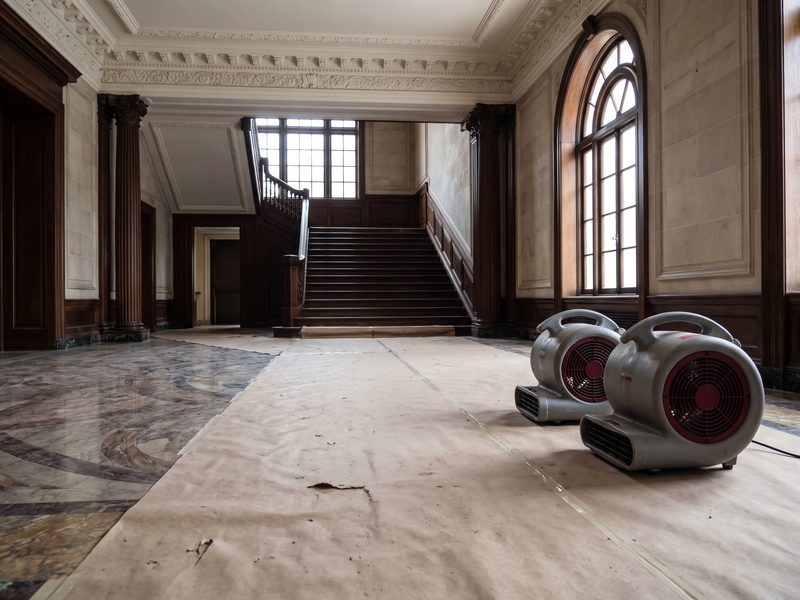
If something does go wrong in the middle of the season, the first hour is what matters. Stop the water at the valve you found in October, move what you can lift, and get a restoration company in to measure the moisture rather than guessing at it. The IICRC S500 standard asks for exactly that. Drying decisions on a row house are driven by what the meters read inside the party wall and under the floor, not by how the surface feels.
The primary guidance behind the seasonal and drying advice above:
- ANSI/IICRC S500, the Standard for Professional Water Damage Restoration, https://iicrc.org/s500/
- Ready.gov winter weather preparation guidance, https://www.ready.gov/winter-weather
- DC Department of Insurance, Securities and Banking consumer guides, https://disb.dc.gov/page/consumer-resources
| Task | Who does it | When |
|---|---|---|
| Clear flat roof drains, scuppers and strainer domes | Roofer | Late October, repeat after final leaf drop |
| Inspect membrane seams, drain collar and penetrations | Roofer | Same visit as the drain clearing |
| Coping joints, parapet cap and counterflashing | Roofer or mason | October, before freeze and thaw starts |
| Rod and flush the areaway drain | Drain contractor | October, after a hose test fails |
| Hose test the areaway drain and clear the grate | Owner | Early October and again in December |
| Boiler or furnace service, relief valve and condensate | Licensed heating technician | September to October |
| Insulate exposed pipe runs and seal foundation air gaps | Owner | October |
| Replace a seized main shutoff valve | Plumber | Before the first hard freeze |
| Drain hose bibs and close interior valves | Owner | First frost forecast |
| Photograph everything and file the paperwork | Owner | As each item is finished |