A Tree Fell on Your DC House: Street Trees, Special Trees and Who Pays
BY RESTORATION DOCTOR OF WASHINGTON DC · WASHINGTON DC & SOUTHERN MARYLAND
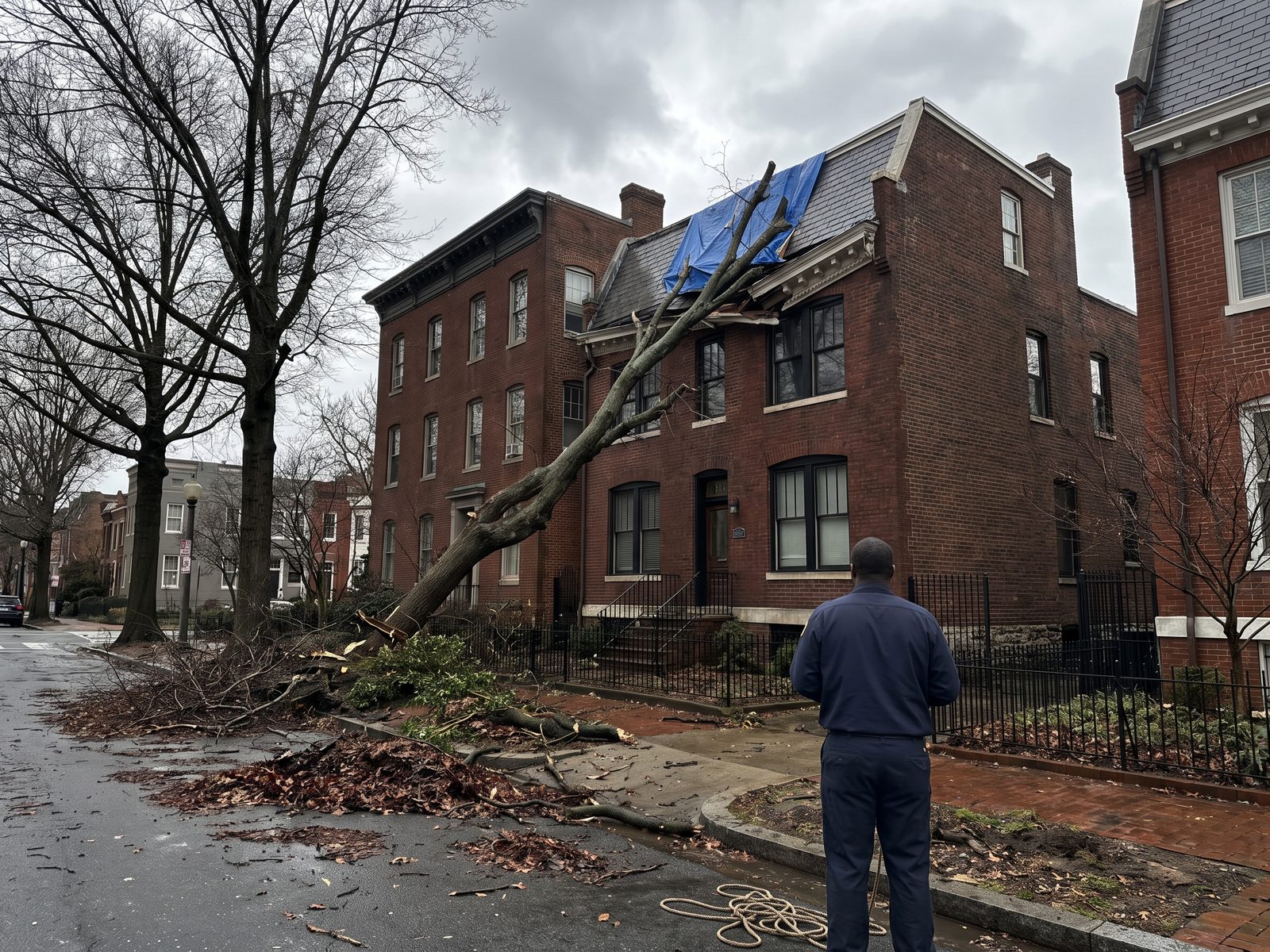
A tree strike is three problems at once: the structural breach, the water pouring through it, and the question of whose tree it was. In the District that last answer depends on whether the trunk stood in public space or qualified as a protected tree, so photograph the trunk and the stump before any crew starts cutting.
Call (202) 922-1444What do you do in the first hour after a tree hits the house?
When a tree fell on your house in DC, who pays splits into two answers that people keep merging into one. Damage to the building and its contents is normally your own homeowners policy's problem, whoever owned the tree. Who cuts the tree up and hauls it away is a separate question, and it turns on where the trunk stood.
None of that matters in the first hour. Get everyone out of the rooms under the impact, because a ceiling holding water fails without warning. Downed wires, a smell of gas or a structure that has shifted make this a 911 call first. Nobody goes up on the roof to look.
Then three calls, in order. Your carrier, to open the claim. A restoration company that can tarp and extract the same day. Then 311, if any part of the tree sits in public space or blocks a street or alley.
- Leave the rooms below the breach and shut the doors
- Kill power to the affected circuits if water is near fixtures
- Call 911 for downed wires, a gas smell or a shifted structure
- Photograph the trunk, the stump and the roofline before anything is cut
Whose tree was it: yours, a neighbor's, or the District's?
Three ownership situations produce three different sets of phone calls, and in the District a fourth sits between them. The strip in front of a row house, between the property line and the sidewalk, is usually public space even though the resident mows it. The tree standing in it belongs to the District.
Work the question from the stump rather than the canopy. Branches lean and crowns spread, so the part that landed on your roof says nothing about ownership. Find the stump, photograph it with something in frame for scale, and note which side of the property line it sits on.
The table below is the short decision tree. It settles no individual claim. Coverage is decided by your policy language, and the District's half by DDOT Urban Forestry.
| Where the trunk stood | Who deals with the tree | Who usually pays for the house |
|---|---|---|
| Your own yard, trunk under 40 inches around | You, through a licensed tree company | Your policy, after the deductible |
| Your own yard, 40 inches or more around | You, under a DDOT Urban Forestry permit | Your policy; permitting does not stop stabilization |
| Public space, including the tree box out front | DDOT Urban Forestry, reported through 311 | Your policy, in the ordinary case |
| A neighbor's yard, tree healthy before the storm | Your neighbor's contractor | Your policy; wind is nobody's fault |
| A neighbor's yard, tree dead and reported in writing | Your neighbor | Your policy first; your carrier may pursue theirs |
| A condominium or cooperative building | The association's contractor | Master policy outside, unit policy inside |
What is a street tree and who is responsible for one in public space?
Street trees here are managed by the Urban Forestry Division at the District Department of Transportation, which calls itself the primary steward of the city's urban forest. Its public portal sits at trees.dc.gov. Those trees are municipal property, so pruning or removing one is not a homeowner's decision to make.
The legal term for the ground they stand on is public parking: the area of public space between the property line and the edge of the sidewalk nearer that line. On many DC blocks the building line sits well back from the curb, so the grass you have watered for years is public space. So is the oak in it.
District law also sets a notice step that reads like inaction from the sidewalk. Before removing a tree on public space, the Director gives the affected Advisory Neighborhood Commission at least 15 days of written notice with the reason. That does not apply to a hazardous tree, which is what a tree on a roof normally is.
What is a Special Tree and why does that status matter now?
The District protects large trees on private land, which is the part most owners never hear about until a storm forces the issue. Under the Urban Forest Preservation provisions of the DC Code, a Special Tree has a circumference between 40 and 100 inches. A Heritage Tree measures 100 inches or more around. Circumference is taken at a height of four and a half feet.
Circumference, not diameter. A tape run around the trunk at chest height gives you the number in under a minute, and it is worth doing before any crew arrives. A mature oak or tulip poplar in a DC back yard clears the Special Tree threshold easily.
District law makes it unlawful to cut down or destroy a Special Tree without a removal permit issued by the District and administered by DDOT's Urban Forestry Division. A permit is issued where the applicant shows the tree is a Hazardous Tree, where regulation marks the species as appropriate for removal, or on payment into the District's Tree Fund. The Tree Fund route is not available for a Heritage Tree, which is why the 100-inch line matters. The code describes a Hazardous Tree partly as one causing damage that cannot be mitigated other than by removal, in the opinion of a certified arborist. A tree across your rafters generally fits. A tree company unfamiliar with that permit is the wrong company for a DC address.
- Measure circumference around the trunk at chest height before anyone cuts
- Between 40 and 100 inches around, District law calls it a Special Tree
- At 100 inches or more it is a Heritage Tree, protected more strictly
- Ask your tree company in writing who is pulling the permit
Who removes the tree, and who pays for the removal?
Removal splits along the property line, and so does the bill. A tree that stood in public space is the District's to clear, through the Urban Forestry Division, once 311 has the report. A tree that stood on private land is the owner's to clear, through a licensed and insured tree company.
That split creates the gap that catches people out. District crews clear public space. The length of trunk resting on your rafters, and the structure under it, belong to your claim and your contractors. Ask each crew to say in writing where their work stops. Two crews each assuming the other has the roof portion is how a house sits open through a second night of rain.
In a condominium or cooperative the association's contractor handles the tree and the building envelope, and the master policy responds for the structure. What the association covers inside your unit varies by the governing documents. Get the declaration and bylaws in front of you early, because the line between building and unit is where these claims stall.
Does homeowners insurance cover the roof, the tree, or both?
Most standard homeowners policies treat wind as a covered peril, which is why a windthrown tree that opens your roof is normally a covered loss. Dwelling coverage responds to the roof, the framing and the interior finishes. Contents coverage responds to what was under the hole. Loss of use may respond while the house is uninhabitable.
Detached structures sit under a different part of the same policy. A tree that flattens a garage or a fence usually falls under the other-structures limit, a percentage of the dwelling amount rather than a separate pot of money. Fence claims disappoint most often, because that limit and the deductible land close together.
Settle two things with the adjuster on day one, in writing. First, that emergency mitigation is authorized, so tarping and drying do not wait on an inspection. Second, how the tree removal benefit is being applied, because the capped debris allowance and the roof repair are separate lines that get confused. We document the loss. We do not decide coverage, and where a carrier is not handling a claim the way the policy reads, the District's Department of Insurance, Securities and Banking takes consumer complaints.
What if it was a neighbor's tree and it was obviously dead?
This is the question owners care about most and the one with the least satisfying answer. Responsibility between neighbors gets decided case by case, and it usually turns on notice: what the owner knew about the tree, and when. A healthy tree brought down by a storm is generally treated as an act of nature. A visibly dead tree left standing after a written warning is a different conversation.
None of that should slow your own repairs. Your policy is built to respond first. If your carrier believes another party is responsible, it can pursue recovery itself, and where it succeeds your deductible often comes back with it. Waiting for a neighbor's insurer to accept fault is how a wet house becomes a moldy one, and growth after a soaking is measured in days.
Keep the evidence and let the carriers argue. Save texts and dated photographs of the tree's condition before the storm. Give your insurer the neighbor's name and address, then let the adjuster take it from there. The roof over your head is the emergency. The liability question is not.
How do you stop the water damage while the tree is still on the roof?
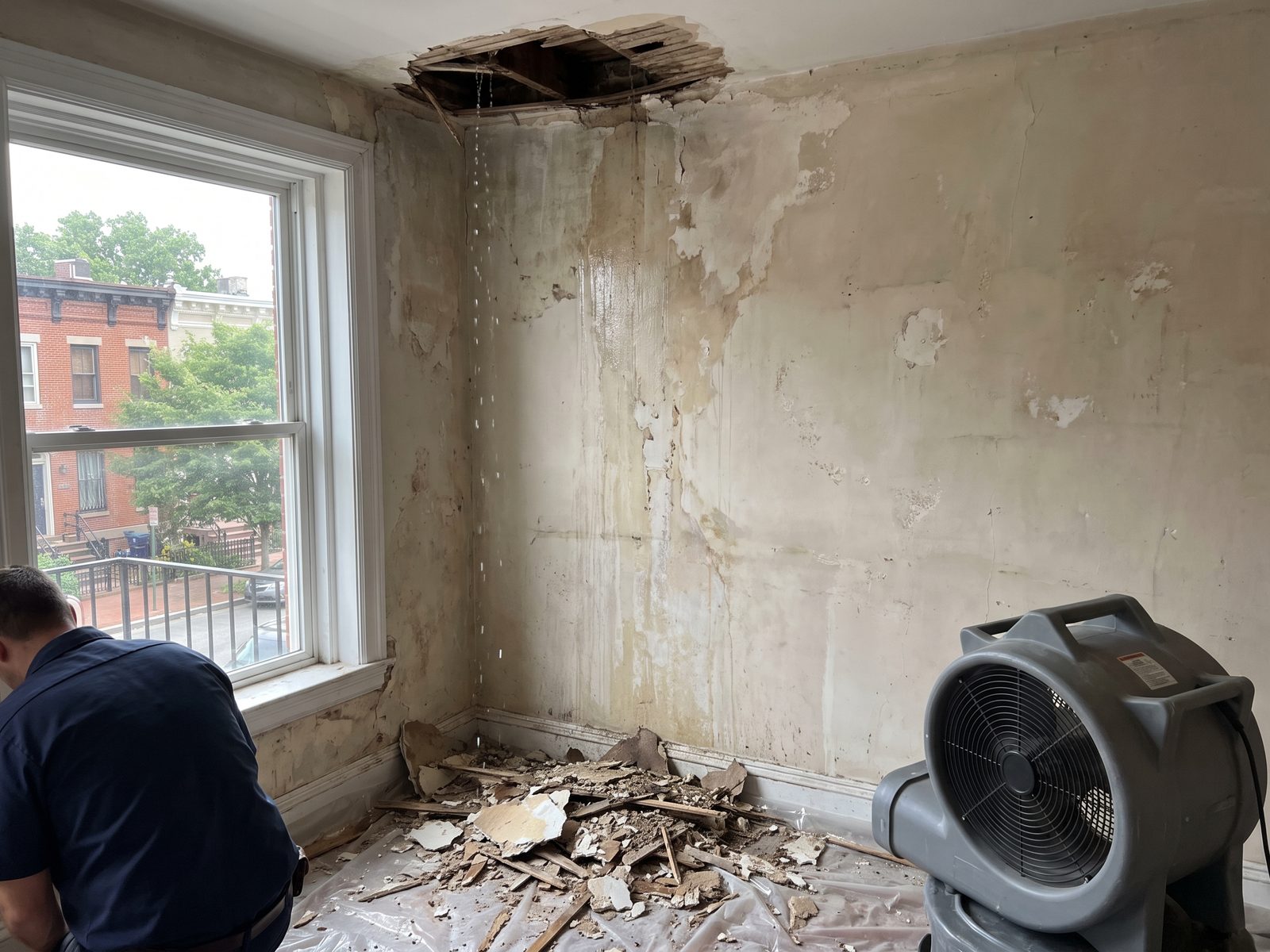
You often cannot dry-in the roof until the tree comes off, and the tree may need rigging or a lift before anything can be cut. Meanwhile the rain keeps finding the hole. So the first line of defense moves indoors, and the goal becomes controlling where the water goes rather than stopping it arriving.
Inside, that means containment and extraction. Poly sheeting and a funnel into a barrel can channel a running leak down a stairwell instead of across three ceilings. Contents come out of the wet rooms or go up on blocks. A bulging ceiling holding trapped water gets relieved deliberately, from the side, with a bucket underneath. That is a technician's job.
Wet insulation is the quiet problem. Blown-in cellulose or fiberglass in a top-floor ceiling holds many times its own weight in water and keeps feeding it into the drywall long after the rain stops. The moisture meter reads the framing and the ceiling board; the insulation above is what keeps those numbers from falling. In most tree strikes it comes out rather than gets dried.
Rainwater through a fresh breach starts as relatively clean water under the IICRC S500 standard, and it does not stay that way. Roofing debris, attic dust and the hours it takes to get the tree off all push it toward a dirtier category. That is why the drying clock starts before the tree is gone.
What does the repair sequence look like: tarp, structure, drying, rebuild?
A tree strike runs through the same ordered stages every time, and skipping one costs money later. Stabilize, remove the tree, dry-in, assess the structure, take out what cannot be saved, dry to a target, then rebuild. That order is not a preference. Rebuilding over framing that still reads wet is the most expensive mistake available after a storm.
Structural assessment is the stage owners tend to skip. A limb that punched through sheathing may also have cracked a rafter or loaded a party wall that was never designed to take a side blow. Framing repairs in the District go through a building permit from the Department of Buildings, and an engineer's letter is often what the permit and the adjuster both want to see.
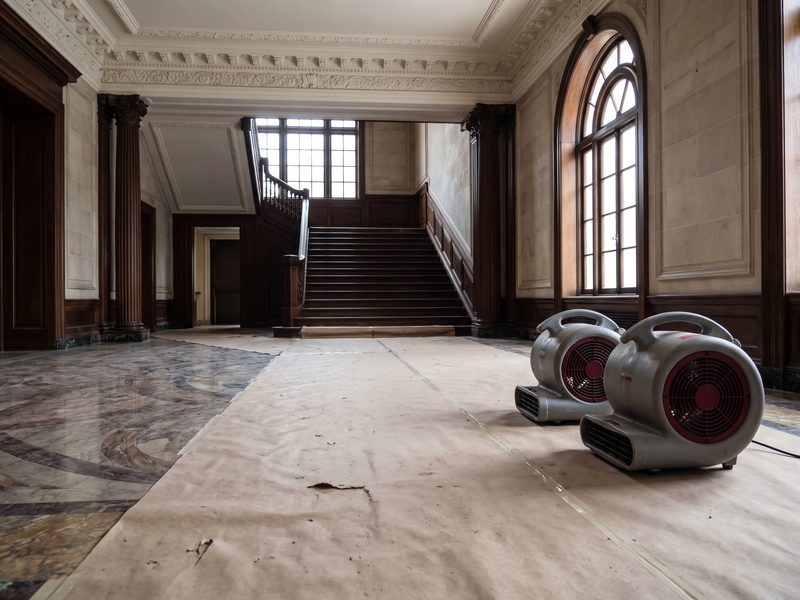
Drying is measured, not guessed. Air movers and dehumidifiers run against daily readings in the affected assemblies until the numbers match unaffected material in the same building. The IICRC S500 standard is where that method comes from, and the drying log is what turns an invoice into something a carrier can check.
The same breach-then-water sequence, written for a coastal market where the storm arrives with a name on it, is on our sister site restorationdoctorfl.com at https://restorationdoctorfl.com/blog/hurricane-water-damage-what-to-do-first. The order of operations there is the one we follow here. What the District adds is the tree regime on top of it.
- Stabilize: make safe, cut power to wet circuits, contain and extract indoors
- Remove: rigging and cutting by a tree company that handles the permit side
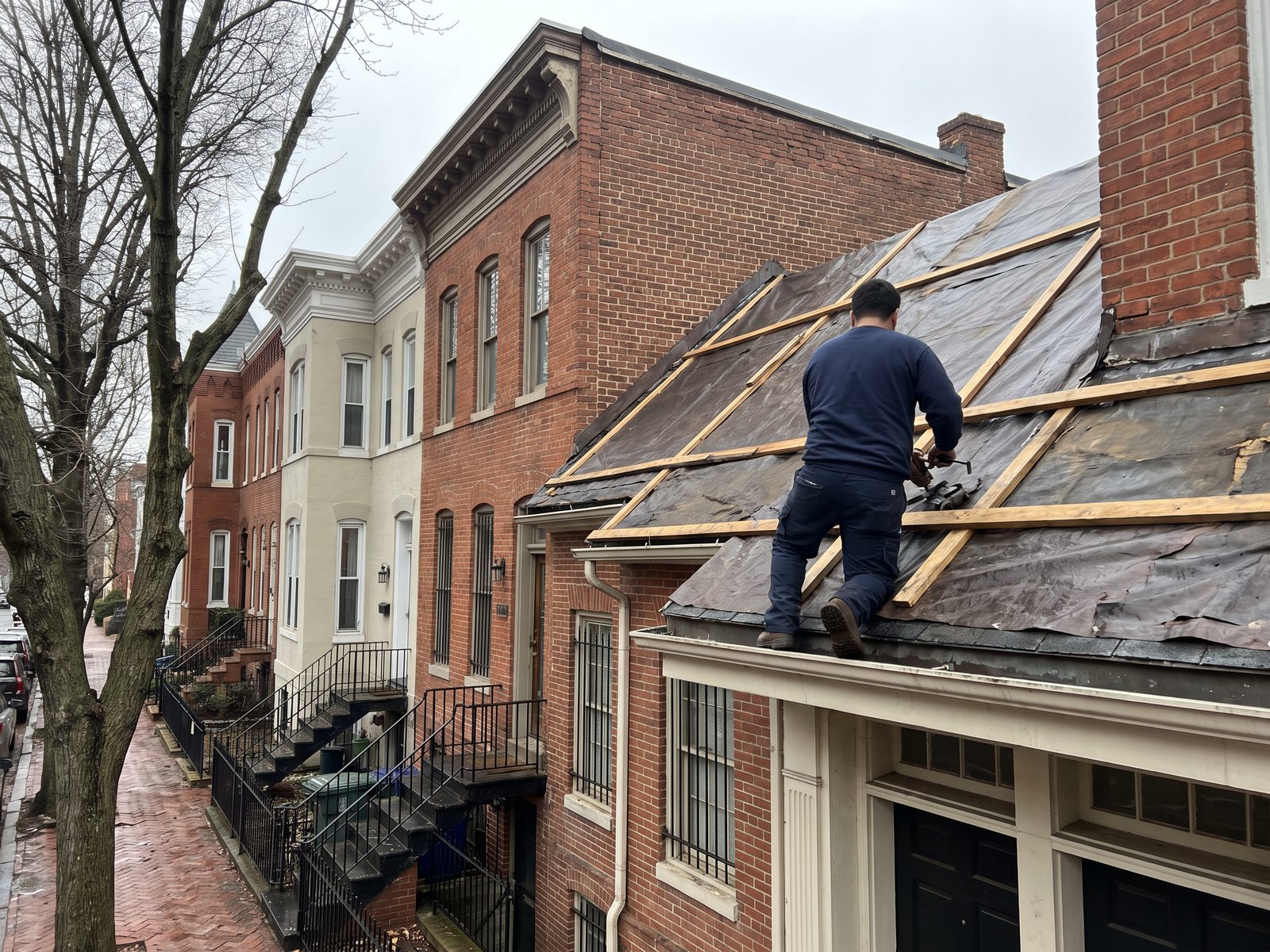
- Dry-in: tarp or temporary decking so the building stops taking on water
- Assess: framing and sheathing checked before anything closes up
- Demolish: wet insulation and unsalvageable ceiling material out
- Dry: metered daily to a documented target, not to a calendar
- Rebuild: roof, ceilings, finishes, under permit where framing was touched
What should you photograph before anything is cut or moved?
Everything you will need in the claim file exists for a few hours, then gets sawn into rounds and hauled to a chipper. Photographs are cheap. Take four times what you think you need: from the street, from the yard, from the doorway of every wet room. Video a slow walk around the outside with the phone held level.
The frames that matter most answer ownership and cause. One wide shot holding the stump, the fallen trunk and your roof together is worth twenty close-ups. Photograph the stump face itself, because rot or hollowing in that cross-section is the evidence of a tree that was failing before the wind arrived.
Keep the originals with their timestamps rather than screenshots, which strip the metadata that makes a photo useful. Back them up before anyone touches the pile. Then write a short dated note of who arrived, at what time and what they did, and put the 311 service request number on it. The sources at the end of this list are the documents behind this article.
- One wide frame with the stump, the trunk and the damaged roof in it
- The stump face in close-up, showing sound wood, rot or hollowing
- The roofline from the street, then the same angle after the tarp goes on
- Every wet room from the doorway, then closer frames of ceilings and contents
- Source: DDOT Urban Forestry, the District's street-tree steward: https://trees.dc.gov/
- Source: DC Code definitions of Special Tree, Heritage Tree and Hazardous Tree: https://code.dccouncil.gov/us/dc/council/code/sections/8-651.02
- Source: DC Code protection of Special Trees and removal permits: https://code.dccouncil.gov/us/dc/council/code/sections/8-651.04
- Source: Notice before removing a tree on public space: https://code.dccouncil.gov/us/dc/council/code/sections/8-651.05
- Source: Report a downed tree or a blocked street to 311: https://311.dc.gov
- Source: DC Department of Buildings, permits for structural repair: https://dob.dc.gov/
- Source: DC Department of Insurance, Securities and Banking, consumer complaints: https://disb.dc.gov/complaints
- Source: IICRC standards, including S500 for water restoration: https://www.iicrc.org/page/IICRCStandards
- Source: EPA guide to mold, moisture and your home: https://www.epa.gov/mold/brief-guide-mold-moisture-and-your-home